Guides · 9 min read
Is today a no-burn day? There is no national answer: how 10 US air districts call a burn ban, and where to check yours
Is today a no burn day? Your local air district decides, often the day before, when PM2.5 is forecast at 25 to 35 µg/m³. Rules, fines and checks for 10 areas.
 By the Good Air team
In this article · 8 sections
There is no national no-burn day in the US: whether today is a no-burn day depends on your local air district, which bans wood fires when it forecasts fine-particle pollution (PM2.5) to reach a set level, usually 25 to 35 micrograms per cubic metre (µg/m³) over 24 hours. Most districts post the call the day before or by the morning it starts: Colorado's forecast comes out at 4 pm, Multnomah County's (Portland) status by 11 am, and Maricopa County (Phoenix) must announce a ban at least three hours before enforcing it.
On the morning of Friday 20 November 2026, none of the five districts whose daily status we could read had a full ban in force. Utah's forecast for Salt Lake County was Unrestricted through Sunday, the Bay Area had no Spare the Air alert, metro Denver had no restrictions until at least 4 pm, Multnomah County was at a voluntary Yellow, and the San Joaquin Valley had two of its ten areas at "No Burning Unless Registered". Check your own district below before you light a fire.
Key findings
- Each area sets its own trigger. Most bans start at a forecast 24-hour PM2.5 of 25 µg/m³ (Utah, the Bay Area, Southern California) to 35 (King County, Sacramento's total ban). The San Joaquin Valley restricts unregistered fireplaces from 12.
- Most seasons started on 1 November and run to the end of February, 1 March in Utah and 31 March in Colorado. The Bay Area and Phoenix can call a ban at any time of year.
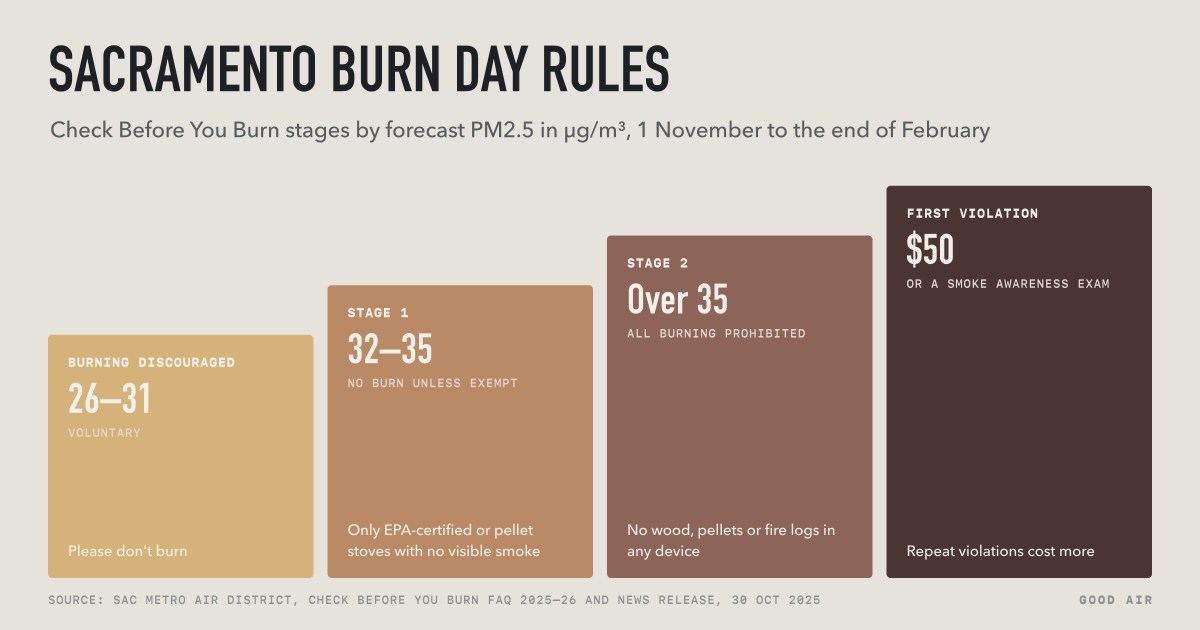
- First fines range from a warning to $150. Maricopa County gives a warning first, Sacramento charges $50, the Bay Area $100 and Utah $150. Southern California no longer sets a fixed amount.
- The air has not reached ban levels yet. In the 30 days to 19 November 2026, no government monitor in Phoenix, northern Utah, the Bay Area, Sacramento County, the South Coast Air Basin or Puget Sound recorded a 24-hour PM2.5 at its area's ban level. Only the San Joaquin Valley's lower 12 µg/m³ line was crossed, on 23 of 30 days.
No-burn day rules by area
Every row comes from the agency's own page, read on 20 November 2026 unless dated otherwise. "Trigger" is the forecast 24-hour average of PM2.5.
| Area and agency | Season | Ban starts at (PM2.5) | When it is called | Fine | Check today |
|---|---|---|---|---|---|
| Phoenix: Maricopa County Air Quality Department | Any time; most likely in winter | Could exceed 30 µg/m³ (also PM10, ozone or CO) | At least 3 hours before enforcement; runs 24 hours from midnight | Warning, then $50, $100, $250 | Clean Air app, 602-506-6400 |
| Salt Lake, Davis, Utah, Weber, Cache (Logan), Box Elder, Tooele: Utah Division of Air Quality | 1 Nov to 1 Mar; can be called any time | 25 µg/m³ (15 under a contingency plan) | Three-day action forecast | $150 first; up to $299 a day | air.utah.gov, UtahAir app, 1-800-228-5434 |
| Bay Area: Bay Area Air District (Spare the Air) | Year-round on alert days; winter is the main season | Above 25 µg/m³ anywhere in the district | Up to three days ahead; email alerts the day before | Course or $100, then $500 | Text START to 81757, 1-877-466-2876 |
| Sacramento County: Sac Metro Air District | 1 Nov to end of Feb | Stage 1 at 32 to 35; Stage 2 above 35 | Status for today and tomorrow | $50 or a wood smoke exam | airquality.org, 1-877-662-8765 |
| San Joaquin Valley (Fresno, Bakersfield): Valley Air District | 1 Nov to end of Feb | 12 µg/m³ for unregistered devices; above 35 for all | Each day, for the next day; midnight to midnight | Citation; amount not on the district's page | Valley Air app, 1-800-766-4463 |
| Los Angeles, Orange, Inland Empire: South Coast AQMD | 1 Nov to end of Feb | Above 25 µg/m³ anywhere in the basin | Alert issued the day before; midnight to 11:59 pm | No fixed amount in the rule | aqmd.gov map, South Coast AQMD app, 866-966-3293 |
| King, Kitsap, Pierce, Snohomish (Seattle, Tacoma): Puget Sound Clean Air Agency | Fall and winter, no fixed dates | Stage 1 above 35 in King and Kitsap within 48 hours, above 30 in Pierce and Snohomish within 72 hours | Not stated; bans usually last a few days | Notice of Violation | pscleanair.gov/168, 800-595-4341 |
| Multnomah County (Portland): Multnomah County Health Department | Not stated | "Poor air quality" expected; no number given | Posted by 11 am; runs noon to noon | Warning or citation | multco.us, text START to 503-994-2876 |
| Metro Denver (Denver, Boulder, Broomfield, Douglas, Jefferson, west Adams and Arapahoe): Colorado Department of Public Health and Environment | November to March | Action Day: generally Unhealthy for Sensitive Groups or worse | Daily at 4 pm, 31 Oct to 31 Mar | Mostly under local ordinances; state penalties up to $15,000 a day | colorado.gov/airquality, 303-758-4848 |
| Reno and Sparks: Northern Nevada Public Health | 1 Nov to end of Feb | Red: a declared Stage 1 emergency episode | Daily; updated as conditions change | Warnings and/or fines | OurCleanAir.com, 775-785-4110 |
Sources: Maricopa P-26, burning, parks; Utah R307-302-3, DEQ, compliance; Bay Area rule, 6-3, FAQ, 4 Feb 2026; Sacramento CBYB, FAQ; Valley Air status, Rule 4901, Oct 2026; South Coast alerts, Rule 445, 2 Nov 2025; Puget Sound bans, FAQ, status; Multnomah; Colorado rules, FAQ, forecast; Washoe code.
Two notes. Salt Lake County also bans burning on Utah's Voluntary Action days. In the San Joaquin Valley, the 12 µg/m³ level used to apply only in Madera, Fresno and Kern; from this winter it covers all eight counties, and outdoor fire pits may be used only on Burning Discouraged days (Valley Air FAQ, December 2023).
What is still allowed, and who is exempt
Every rule above targets wood and other solid fuels, so gas and propane fireplaces are not covered. Cooking is mostly allowed: Maricopa and Multnomah counties exempt grills and smokers, and South Coast AQMD allows charcoal in a barbecue grill but not wood-fired cooking at home (South Coast AQMD FAQ). Other exemptions are narrow and usually need approval first:
- Only source of heat. Every district has a version. The Bay Area accepts only a registered EPA-certified or pellet stove; Utah needs a stove registered with the state; Maricopa County stopped issuing new permanent exemptions after 1995.
- Low income. Sacramento, Multnomah County (income at or below 60% of the Oregon median) and Maricopa County (temporarily, under state assistance guidelines) allow it. South Coast AQMD's rule no longer does.
- Clean stoves. Certified, pellet or registered stoves that make no visible smoke may still run on a Sacramento or Puget Sound Stage 1 day, a San Joaquin Valley "No Burning Unless Registered" day, a Colorado Action Day and a Maricopa No Burn Day. Stage 2 days, Utah Mandatory Action days and Bay Area or South Coast alerts ban them too.
- Place. The San Joaquin Valley exempts homes with no natural gas service; Southern California exempts homes with no gas line within 150 feet, homes 3,000 feet or more above sea level, and the Coachella Valley and High Desert. Colorado's restriction stops at 7,000 feet.
Is today a no-burn day? Status on 20 November 2026
What the districts showed on Friday morning, Pacific and Mountain time:
- Utah: Unrestricted Action for Friday, Saturday and Sunday in the Salt Lake County forecast, updated at 8:25 am (Utah DAQ forecast).
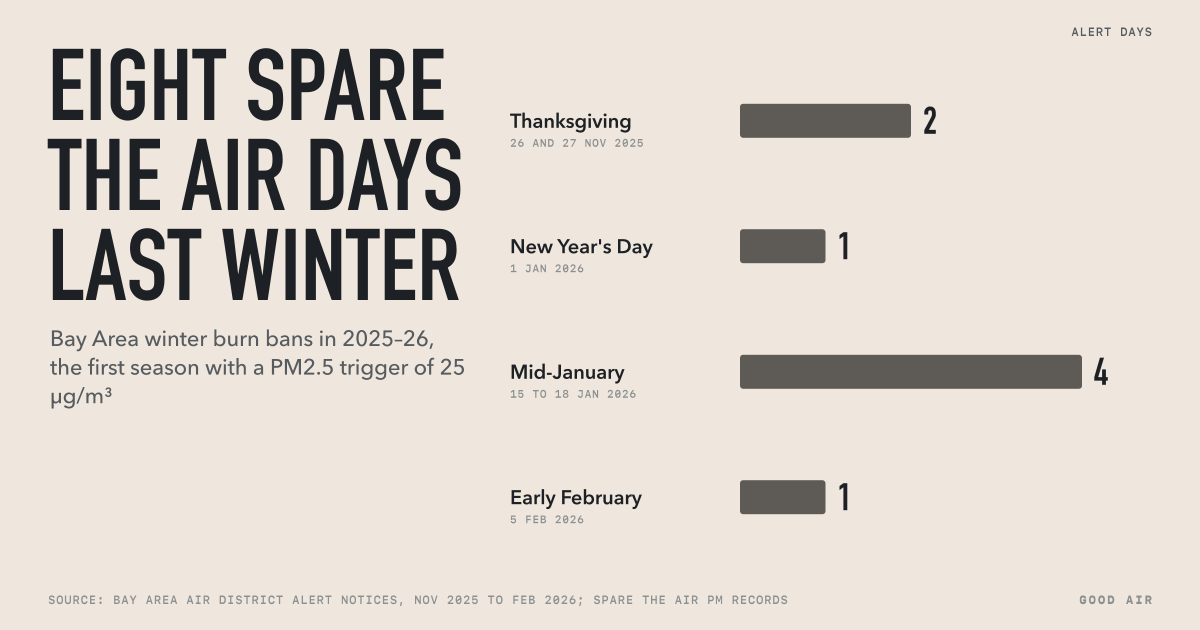
- Bay Area: no Spare the Air alert. The district's records still showed 6 alerts in 2026, all from last winter, so none had been called this season (Spare the Air, PM data).
- Metro Denver: "No Indoor Burning Restrictions" until at least 4 pm Friday, in the forecast issued at 4 pm on 19 November (Colorado air quality forecast).
- Multnomah County: Yellow, updated at 7:49 am: limit burning, and don't burn unless it is your only heat (Multnomah County).
- San Joaquin Valley: Burning Discouraged in eight of the ten areas listed and No Burning Unless Registered in two. On 19 November all ten were Burning Discouraged (Valley Air burn status).
We could not read a dated status for Phoenix, Sacramento, Southern California, Puget Sound or Reno, so use the lines in the table. Reno rarely bans: in 2024–25 the code was Green on 117 of 120 days and Yellow on 3, and the last Red day was 29 December 2017 (Northern Nevada Public Health, 30 October 2025).
What the AQI has to do with it
Burn bans are set in PM2.5 concentrations, not AQI numbers, but you can translate them with the EPA's scale: Good is 0 to 9.0 µg/m³, Moderate 9.1 to 35.4 and Unhealthy for Sensitive Groups from 35.5 (EPA, February 2024).
| Trigger (24-hour PM2.5) | About this on the US AQI | Used by |
|---|---|---|
| 12 µg/m³ | 56 (Moderate) | San Joaquin Valley, unregistered devices |
| 25 µg/m³ | 81 (Moderate) | Utah, Bay Area, Southern California |
| 30 µg/m³ | 90 (Moderate) | Phoenix; Pierce and Snohomish counties |
| 32 to 35 µg/m³ | 94 to 99 (Moderate) | Sacramento Stage 1 |
| Above 35 µg/m³ | About 100 and up | Sacramento Stage 2, San Joaquin Valley total ban, King and Kitsap counties |
So most bans begin while the air is still Moderate, or yellow, on the AQI. That is deliberate: the Bay Area lowered its trigger from 35 to 25 on 1 October 2025 so alerts come "earlier, before pollution builds up" (Bay Area Air District, 4 February 2026). A ban is called on a 24-hour forecast, often before the smoke shows on a live map. Read more on what Moderate means.
Has the air reached ban levels yet?
Not outside the San Joaquin Valley. We checked every permanent government PM2.5 monitor in each area against its rule, using EPA AirNow's 24-hour averages for 21 October to 19 November 2026.

| Area | Monitors | Ban trigger (µg/m³) | Days at trigger, of 30 | Highest day (µg/m³) |
|---|---|---|---|---|
| San Joaquin Valley, unregistered devices | 19 | 12 | 23 | 32.1, Fresno-Garland, 6 Nov |
| Northern Utah | 20 | 25 | 0 | 21.2, Rose Park (Salt Lake City), 12 Nov |
| Sacramento County, Stage 1 | 6 | 32 | 0 | 19.7, Bercut Drive, 8 Nov |
| King and Kitsap counties | 12 | Above 35 | 0 | 19.0, Auburn, 2 Nov |
| Pierce and Snohomish counties | 6 | Above 30 | 0 | 18.9, Tacoma, 2 Nov |
| South Coast Air Basin | 15 | Above 25 | 0 | 17.4, Compton, 7 Nov |
| Maricopa County | 8 | Above 30 | 0 | 14.9, Phoenix JLG Supersite, 6 Nov |
| Bay Area | 8 | Above 25 | 0 | 14.5, Livermore, 8 Nov |
- The San Joaquin Valley is the exception. At least one monitor reached 12 µg/m³ on 23 of 30 days, and on 20 of 30 days in Fresno County alone. None went above 35, the level that bans every device. Fresno and Bakersfield have the valley's live readings, and why Fresno's air is so bad explains the valley's bowl.
- Utah came closest elsewhere. Rose Park reached 21.2 µg/m³ on 12 November, 3.8 below the mandatory line. The other 19 northern Utah monitors stayed at 15.9 or below.
- The last week was cleaner. From 13 to 19 November only three valley days reached 12.
These are measured days, not declared ones. Districts ban on forecasts, so a ban can come on a day that measures lower, and the reverse.
How to check if today is a no-burn day where you live
- Use your district's own line, from the table above. Only its declaration counts.
- Watch the forecast the evening before. Our city pages show the live US AQI and tomorrow's AirNow forecast where one exists: Phoenix, Salt Lake City, Provo, San Francisco, San Jose, Sacramento, Los Angeles, Seattle, Portland, Denver and Reno. A PM2.5 forecast of 81 or more on the AQI is at or above the 25 µg/m³ trigger used in Utah, the Bay Area and Southern California.
- Read the local guide: Phoenix No Burn Days, Salt Lake City inversion season, Bay Area Spare the Air, Sacramento Check Before You Burn, Los Angeles No-Burn Days and Seattle burn bans.
For other cities, see the live US air quality ranking and the California and Utah pages.
How we measured
- Rules. From each agency's own page or rule text, read on 20 November 2026. Where a page did not say something, such as a fine, we say so. We left out areas where we could not open an agency page describing a winter wood-burning ban.
- Air data. EPA AirNow's daily files (files.airnowtech.org): each monitor's 24-hour PM2.5 for each local day. Preliminary government data; permanent monitors with at least 24 of the 30 days from 21 October to 19 November 2026.
- Areas. Monitors in the counties or district each rule covers, without the Coachella Valley and mountain sites in Southern California, or Mojave and Sierra forest sites in the San Joaquin Valley.
- Trigger days. A day counts when at least one monitor met the rule's level as worded ("exceed 25" means above 25). US AQI uses the EPA's 2024 breakpoints.
Frequently asked questions
Is today a no burn day in my area?
Only your local air district can tell you. There is no national no-burn day: each district calls its own ban from its PM2.5 forecast, usually the day before or by the morning it starts. Check its app, phone line or text alerts; the table above lists them for Phoenix, Utah, the Bay Area, Sacramento, the San Joaquin Valley, Southern California, Puget Sound, Portland, Denver and Reno.
What time are no-burn days announced?
It depends on the district. Colorado issues its Denver forecast at 4 pm each day from 31 October to 31 March. Multnomah County posts its status by 11 am, and it runs from noon to noon. The Bay Area can call an alert up to three days ahead, the San Joaquin Valley declares each day's status the day before, Southern California has issued its alerts the day before, and Maricopa County must give at least three hours' notice.
What PM2.5 level triggers a burn ban?
Most districts ban wood burning when 24-hour PM2.5 is forecast at 25 to 35 µg/m³, which is about 81 to 100 on the US AQI. Utah, the Bay Area and Southern California use 25, Maricopa County 30, and Sacramento's total ban and King County's ban start above 35. The San Joaquin Valley restricts unregistered devices from 12.
Can I use a gas fireplace or fire pit on a no-burn day?
A gas or propane fireplace or fire pit, yes, in every area we checked. A wood-burning fire pit or chiminea, no: outdoor wood fires are included in the bans. Cooking on a grill is generally allowed, though rules on charcoal and wood for cooking vary by district.
What is the fine for burning on a no-burn day?
It varies. Maricopa County starts with a warning, then $50, $100 and $250. Sacramento charges $50 or a wood smoke exam for a first violation, the Bay Area $100 or a course, and Utah $150, with penalties up to $299 a day. Southern California's Rule 445 no longer sets a fixed fine.