News · 7 min read
Southeast Asia haze 2026: smoke returns to Singapore and Malaysia as Sumatra and Kalimantan burn on
Southeast Asia haze 2026, 24 Oct update: Singapore's PSI back above 100, 16 Malaysian areas unhealthy, fires still burning in Indonesia. Data and outlook.
 By the Good Air teamUpdated · First published 14 October 2026
In this article · 8 sections
The Southeast Asia haze of 2026 is not over: on Friday 23 October Singapore's 24-hour PSI climbed back to 85 to 108 by 6 pm as smoke from Sumatra returned, and 16 areas in Malaysia were Unhealthy on the Air Pollutant Index (API). At 11 am on Saturday 24 October, Good Air's live reading for Singapore was a US AQI of 168 (Unhealthy), while fires in South Sumatra and Kalimantan kept the air near them far worse.
Relief may come within days. Singapore's National Environment Agency (NEA) expects winds to turn from the southwest or west from Sunday 25 October, and the region's monsoon rains usually return from late October. Until the peat fires are out, the smoke can come back.
Latest: 24 October 2026
- Singapore. At 6 pm on 23 October the 24-hour PSI was 85 to 108 (Moderate to Unhealthy), up from 71 to 96 a day earlier, and one-hour PM2.5 was 70 to 98 µg/m³. NEA forecast 90 to 140 for 24 October, with showers, and said winds from the southwest or west from Sunday may reduce the smoke (NEA, 23 October; NEA, 22 October).
- Malaysia. At 10 am on 23 October, 16 areas were Unhealthy (API 101 to 200), led by Johan Setia in Selangor at 159, then Klang and Seremban at 158 (The Star, 23 October). Schools in Selangor, Negeri Sembilan, Melaka, Pahang and Penang were to reopen on 19 October, with outdoor activities restricted (The Vibes, 18 October). Which stations had the most unhealthy days: Malaysia haze October 2026, worst-hit areas.
- Sumatra. On 23 October, 24 of the 33 Sumatran cities and regencies with monitors had a daily ISPU above 100 (Unhealthy), one short of the season's high of 25 on 16 October. At 10 am WIB on 24 October Palembang read a US AQI of 216 and Pekanbaru 155 at 9 am. Since 16 October Indonesia has seeded clouds with dry ice around Palembang, where visibility fell to 50 metres on 15 October; by 22 October there had been 18 seeding flights, and the operation is extended to 5 November (BMKG, 23 October). Smoke also returned over North Sumatra on 22 October: see our Indonesian report on kabut asap Medan.
- Kalimantan. 17 of 24 places with monitors were above ISPU 100 on 23 October. Palangka Raya, on a single monitor, was at the top of the US AQI scale, 500, at 9 am WIB on 24 October. BMKG says smoke is trapped under an inversion layer at up to 6,000 to 7,000 feet, and that visibility was improving gradually where dry ice was used (BMKG, 20 October).
- Region. The ASEAN Specialised Meteorological Centre (ASMC) had Alert Level 3, its highest, in force for the southern ASEAN region when we checked on 24 October, with hotspots widespread in southern Kalimantan and southern and central Sumatra (ASMC).
The 2026 haze in numbers
Good Air archives hourly readings from government monitors in all three countries. From 15 September to 23 October 2026 (39 days):
- Singapore had a daily mean PM2.5 above 55.4 µg/m³, the level at which the US AQI turns Unhealthy, on 20 of 39 days. The worst day was 15 October, at 139.1 µg/m³. The air cleared to 33.3 on 22 October, then rose to 76.5 on 23 October.
- Malaysia recorded 920 of 2,650 station-days (35%) with a daily API above 100. The most stations Unhealthy on one day were 44 of 68 on 15 September and 42 on 7 October; on 23 October it was 22.
- Sumatra had 664 of 1,238 place-days (54%) above ISPU 100, and the count is not falling: 25 places on 16 October, 24 on 23 October. Full ranking: Sumatra haze 2026, unhealthy days by regency.
- Kalimantan was worst of all: 687 of 930 place-days (74%) above ISPU 100, and between 15 and 22 places Unhealthy every single day. See Kalimantan haze.
| Week (2026) | Singapore mean PM2.5 (µg/m³) | Malaysia stations above API 100, daily average (of 68) | Sumatra places above ISPU 100, daily average | Kalimantan places above ISPU 100, daily average |
|---|---|---|---|---|
| 15–21 Sep | 36.2 | 32.7 | 16.7 | 18.3 |
| 22–28 Sep | 40.5 | 9.3 | 10.3 | 17.9 |
| 29 Sep–5 Oct | 47.8 | 14.6 | 16.9 | 15.7 |
| 6–12 Oct | 89.7 | 32.1 | 17.7 | 17.7 |
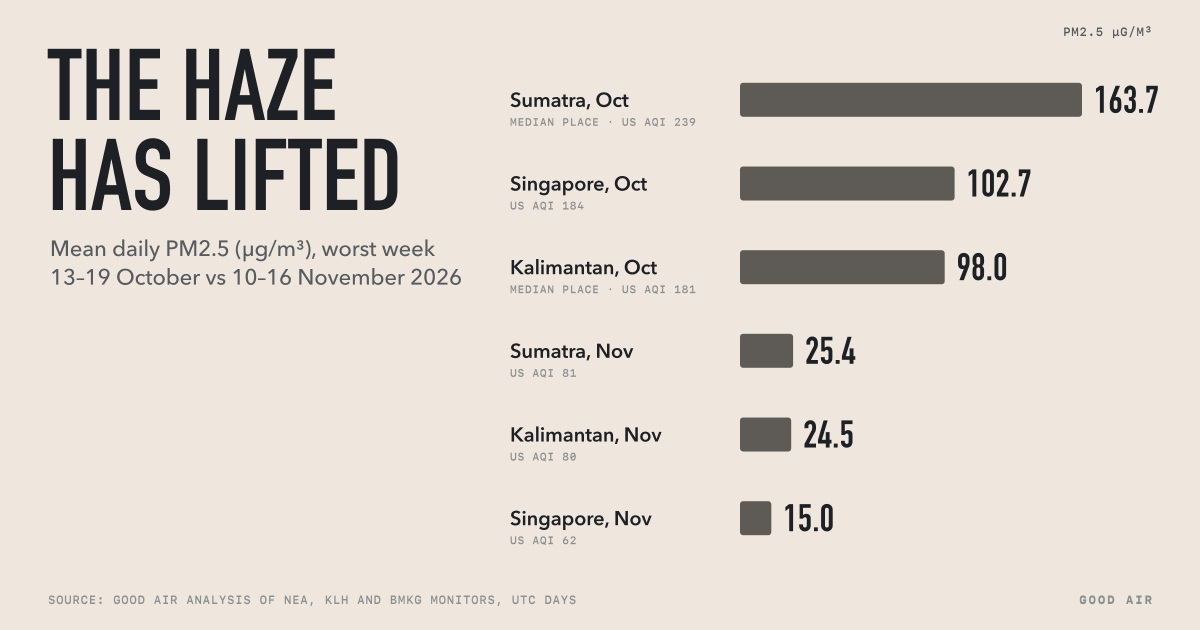
| 13–19 Oct | 102.7 | 30.3 | 22.4 | 18.6 |
| 20–23 Oct | 53.9 | 21.8 | 19.0 | 17.5 |
Singapore and Malaysia have eased since mid-October; Sumatra and Kalimantan have not.
What is burning, and how the haze spread
Fires on carbon-rich peatland in Sumatra and Kalimantan, Indonesian Borneo, are the source. On the evening of 7 October Indonesia's Forestry Ministry counted 1,176 high-confidence hotspots, led by Central Kalimantan (225) and South Sumatra (224), then West Kalimantan (47), South Kalimantan (31) and Jambi (16) (The Edge Malaysia, 8 October). On 14 October BMKG, Indonesia's weather agency, counted 1,297, with 505 in Sumatra and 346 in Kalimantan (iNews via RCTI+, 16 October). We found no official count for the past week.

How the worst of it unfolded:
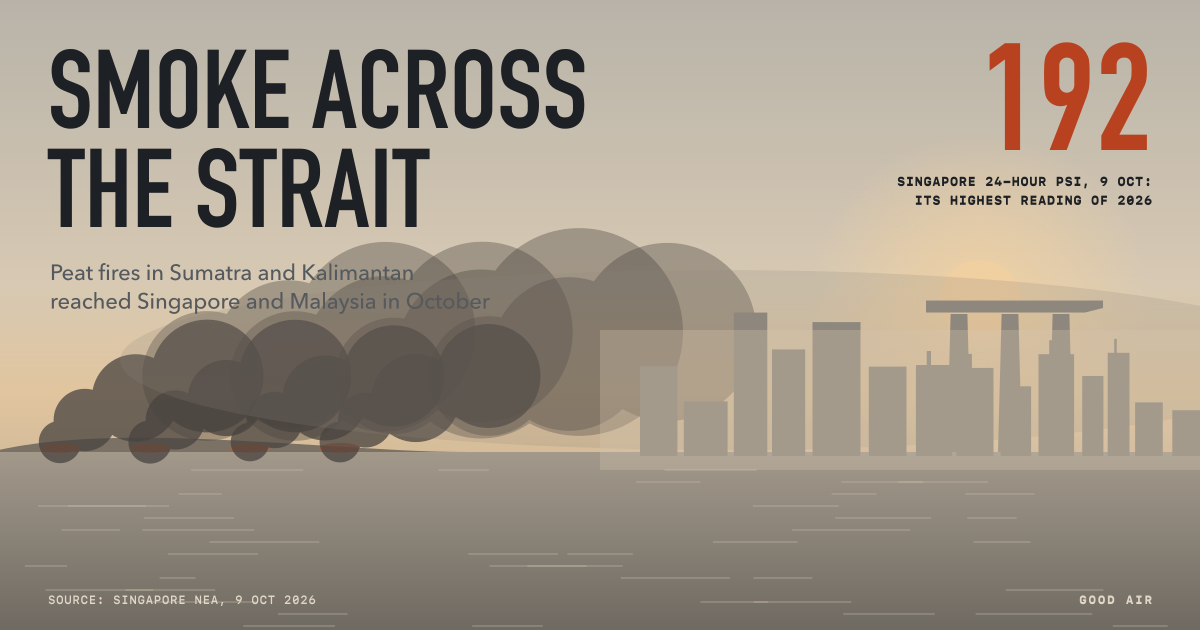
- 9 October. Singapore's 24-hour PSI reached 192, with one-hour PM2.5 up to 123 µg/m³ (NEA, 9 October). Malaysia shut schools in seven states and territories, affecting about two million students (Al Jazeera, 9 October); more in Malaysia haze school closures.
- 14 October. 27 of Malaysia's 68 stations read Unhealthy, with Pasir Gudang in Johor highest at 177 (Malay Mail via Yahoo News, 14 October).
- 15 October. Singapore's worst day: the PSI in the west reached 212 at noon, Very Unhealthy. ActiveSG closed outdoor facilities and the ISCA Run was cancelled (The Straits Times via Yahoo News, 15 October).
- 18 October. Eight Indonesian cities and regencies were Hazardous on ISPU, led by Kotawaringin Timur in Central Kalimantan at 714 (Bernama, 17 October; our Kalimantan haze update).
Why peat fires make the worst haze
Peat is partly decomposed plant matter built up over thousands of years in waterlogged swamp forest. Drained for plantations, it dries out and becomes fuel. Once alight, peat smoulders underground for weeks, producing far more smoke per hectare than a forest fire, rich in fine particles (PM2.5) and carbon monoxide. Rain and water-bombing can douse the surface while the fire keeps burning below.
PSI, API, ISPU and AQI: four numbers for the same smoke
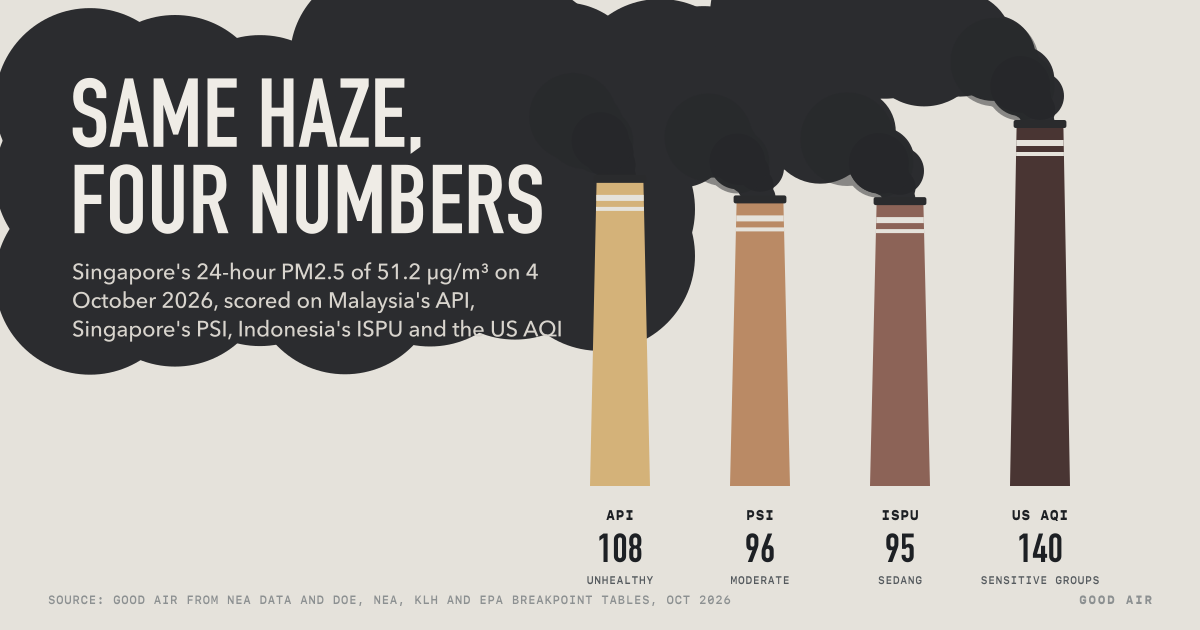
Each country reports the haze on its own index, which is why numbers in the news rarely match. Indonesia's is explained in What is ISPU?, and our API vs PSI vs ISPU explainer shows what each index says for the same PM2.5.
| Country | Index | How it is averaged | Unhealthy from |
|---|---|---|---|
| Singapore | PSI (NEA) | 24 hours | 101 |
| Malaysia | API (Department of Environment) | 24-hour running average, published hourly | 101 |
| Indonesia | ISPU (Ministry of Environment) | 24 hours | 101 |
| US scale, used by Good Air | US EPA AQI | Latest hour | 151 (101 for sensitive groups) |
The 24-hour indices move slowly. For deciding whether to go out right now, the one-hour PM2.5 reading is the better guide.
How to protect yourself from haze
- Check the hourly reading before you go out, and plan outdoor time for when it is lowest.
- Wear a well-fitted N95 or FFP2 respirator outdoors when the air is Unhealthy. Surgical and cloth masks let most fine particles through.
- Keep windows and doors closed, and run an air purifier with a HEPA filter in the room you use most, especially at night. Set the car's air conditioning to recirculate.
- Move exercise indoors. See what to do at each AQI level.
- Take extra care with children, older relatives, pregnant people and anyone with asthma, COPD or heart disease; our guide on protecting children from air pollution covers what parents can do. Seek medical help for chest pain or severe breathlessness.
When will the haze stop?
Not for certain this week. The haze ends when steady rain soaks the peatlands of Sumatra and Kalimantan.
- The monsoon is turning. ASMC expects the southwest monsoon to give way to inter-monsoon conditions toward the end of October, with light, variable winds and more showers that could ease the haze, though the risk persists (ASMC, read 24 October). Malaysia's weather service, MetMalaysia, put the inter-monsoon period at 9 October to the end of October (The Star, 6 October).
- Rain at home is not enough. An air quality researcher at Universiti Malaysia Perlis expects gradual improvement by the end of October but warned that rain in Malaysia alone cannot end the haze while fires burn in Indonesia, and that recovery may be uneven (New Straits Times, 20 October).
- Indonesia is still fighting the fires. The dry-ice seeding around Palembang now runs to 5 November (BMKG, 23 October).
What is not known: how many hotspots are burning now, since cloud cover has limited satellite counts (NEA, 22 October), and whether rain will reach the fire areas. ASEAN ministers are due to discuss the haze at November's meetings (Jakarta Post, 13 October). Follow it live on the Southeast Asia haze tracker.
How we measured
Our figures are daily means (UTC days) of hourly readings from NEA (Singapore, 5 stations combined), Malaysia's Department of Environment (68 stations; the API is a 24-hour running average) and Indonesia's KLH and BMKG monitors, combined per city or regency. Many Indonesian regencies have one monitor. Sumatra and Kalimantan are grouped by monitor location. Some Kalimantan monitors report daily ISPU far above 500, which we treat as unreliable and do not quote; they count only as "above 100". 23 October has 21 hours of data. Live readings are from Good Air's pages at the times stated.
Frequently asked questions
Is there haze in Singapore today?
Yes, at a lower level than mid-October. At 6 pm on 23 October the 24-hour PSI was 85 to 108, and NEA forecast 90 to 140 for 24 October. At 11 am on 24 October Good Air's live reading for Singapore was a US AQI of 168, Unhealthy. Check the one-hour PM2.5 before going out.
When will the haze stop in 2026?
No one can give a date. NEA expects winds from 25 October to carry less smoke to Singapore, and the inter-monsoon rains usually arrive from late October. The haze ends for good only when rain puts out the peat fires in Sumatra and Kalimantan.
Where does the haze come from?
From peat and forest fires in Indonesia, mainly South Sumatra, Jambi, Riau and Central and South Kalimantan. Winds carry the smoke to Singapore and Peninsular Malaysia.
Which areas in Malaysia are worst hit by the haze?
The belt from Johor to Selangor. At 10 am on 23 October, Johan Setia (159), Klang and Seremban (158) were highest. From 1 to 22 October, Nilai and Batu Pahat had an unhealthy API on 20 of 22 days.
Do N95 masks work against haze?
Yes, if they fit well. N95 and FFP2 respirators filter at least 94 to 95 percent of fine particles when sealed around the face. Surgical and cloth masks offer little protection.