Seasonal · 7 min read
UAE fog alert season 2026–27: six alert mornings so far, and the worst months are still ahead
UAE fog alert season is under way: NCM fog alerts on at least six mornings since 26 September 2026. When fog peaks, what alerts mean, roads and fines.
 By the Good Air team
In this article · 7 sections
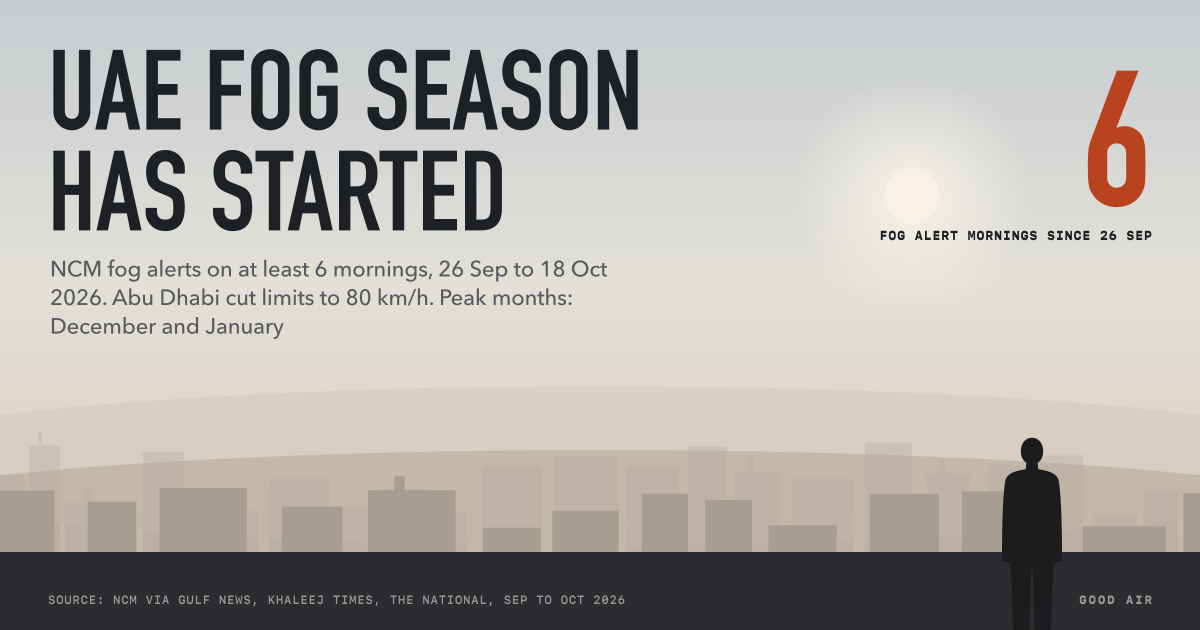
The UAE's fog season has started early: the National Centre of Meteorology (NCM) issued fog alerts on at least six mornings between 26 September and 18 October 2026, and Abu Dhabi Police cut speed limits to 80 km/h on at least five of those mornings. The foggiest months, December and January, are still ahead, and NCM's forecast for 23 to 27 October again included early-morning fog or mist over coastal and inland areas (Gulf News, 23 October).
When is fog season in the UAE?
Fog in the UAE runs from about September to March. A 36-year study of weather reports at Abu Dhabi International Airport found fog from September through March, with December and January the most active months. The airport averaged about 24 fog days a year, but anywhere from 8 to 51 (Weston and others, Journal of Applied Meteorology and Climatology, 2021). NCM also names December, January and February as the months when fog is most frequent, because nights are coolest then (Gulf News, 6 October 2026).
Not everyone agrees on the peak: Ibrahim Al Jarwan of the Emirates Astronomical Society says October, November and March each usually have more than 12 foggy days (Gulf News, 10 October 2026), while the airport study found few in November. We found no official national monthly fog count.
Most UAE fog is radiation fog: on clear, calm, humid nights the ground cools the air above it until its moisture condenses. NCM lists three conditions: high humidity, clear skies and light winds; a stronger wind stops fog forming (Gulf News, 10 October). At the airport, fog is most likely around sunrise.
UAE fog alerts so far this season
These are the fog alerts we could confirm in dated reports. There may have been others.
| Morning | NCM alert | Abu Dhabi speed limits | Source |
|---|---|---|---|
| Sat 26 September | 11 pm Friday to 8:30 am; visibility "virtually zero at times" | 80 km/h on 9 roads, incl. Abu Dhabi–Al Ain Road, Al Taff Road, Sweihan Road | Gulf News, 26 Sep |
| Wed 30 September | 1 am to 9 am; visibility below 1,000 m | 80 km/h on 6 sections in Al Dhafra, incl. Umm Al Hosn Road (Liwa to Ghayathi) | Gulf News, 30 Sep |
| Tue 6 October | Fog alert; more mist forecast until Saturday | 80 km/h on key routes, back to normal at 8:15 am | The National, 6 Oct |
| Fri 16 October | Fog until at least 9 am | 80 km/h in parts of Abu Dhabi; Dubai Police urged drivers to slow down | The National, 16 Oct |
| Sat 17 October | Red and yellow fog alerts, coastal and inland areas | Not reported | Khaleej Times, 17 Oct |
| Sun 18 October | 1:30 am to 9 am, coastal and inland areas | 80 km/h on 8 sections, incl. Abu Dhabi–Al Ain Road (Abu Samra to Al Salamat) and four on Sweihan Road | Gulf News, 18 Oct |
On 10 October NCM also warned of four days of night and early-morning fog from Saturday to Tuesday, with visibility possibly near zero in coastal and inland areas, "especially in the west" (Gulf News, 10 October). As of 24 October we found no report of a fog alert after 18 October, though NCM's outlook for 23 to 27 October included morning fog or mist every day.
Where fog is worst
The roads named again and again are inland Abu Dhabi: Sweihan Road and Al Taff Road, the Abu Dhabi–Al Ain Road, and the Al Dhafra roads to Madinat Zayed and Liwa in the west. Sweihan Road appeared in all three detailed lists. Dubai Police asked drivers on 16 October to slow down "in accordance with road conditions" but announced no limit change.
What do yellow, orange and red fog alerts mean?
NCM colours its weather alerts by risk. Fog is defined by horizontal visibility below 1,000 metres; above 1 km it is mist (Gulf News, 6 October 2026).
| Colour | What it means |
|---|---|
| Yellow | Caution needed because of potentially hazardous weather; stay alert to changing conditions (Gulf News, 18 October 2026) |
| Orange | A higher level of risk: be prepared and follow the authorities' instructions (same source) |
| Red | Be extremely vigilant: hazardous events "of exceptional severity" are forecast (Khaleej Times, 11 June 2023) |
Fog alerts often come as red and yellow together, as on 17 October 2026 and on 12 February 2026, when heavy fog covered the country for a third straight day (Khaleej Times, 12 February 2026). We could not find a published visibility threshold for each colour. NCM's map shows which areas are under which colour.
Speed limits and fines in fog
Abu Dhabi's variable speed limits began in April 2019 and are used in heavy rain, sandstorms and fog. The lower limit, usually 80 km/h, appears on electronic signboards and police social media (The National, 6 October 2026). It overrides the normal posted limit.
| Offence | Penalty | Source |
|---|---|---|
| Up to 10 km/h over the reduced limit | Dh300; doubled for up to 20 km/h over | The National, 6 Oct 2026 |
| More than 80 km/h over the limit | Dh3,000, 23 black points, 60-day vehicle seizure | Gulf News, updated 23 Mar 2026 |
| Driving with hazard lights on | Dh500, 4 black points | Same source |
| Changing lanes without indicating | Dh400 | Same source |
| Heavy vehicles, trucks and buses moving in fog (Abu Dhabi) | Dh500, 4 black points (Article 104, Resolution 178 of 2017) | Khaleej Times, 9 Sep 2021 |
Abu Dhabi Police say to switch hazard lights on only once you have pulled over and stopped (Gulf News, 1 November 2018). Fines change; check with the police before relying on an amount.
Police advice on 18 October 2026: check NCM and police updates, delay the trip if visibility is very poor, use low beams or fog lights, leave extra distance, avoid cruise control, and if fog gets too thick pull off the road into a safe area (Gulf News, 18 October).
Does fog make UAE air quality worse?
Radiation fog forms in calm, stable air, with cool air trapped near the ground beneath warmer air (Gulf News, 6 October 2026). That lack of mixing can hold particles near the ground too. The airport study also linked November's few fog days to fewer aerosol particles in the air.
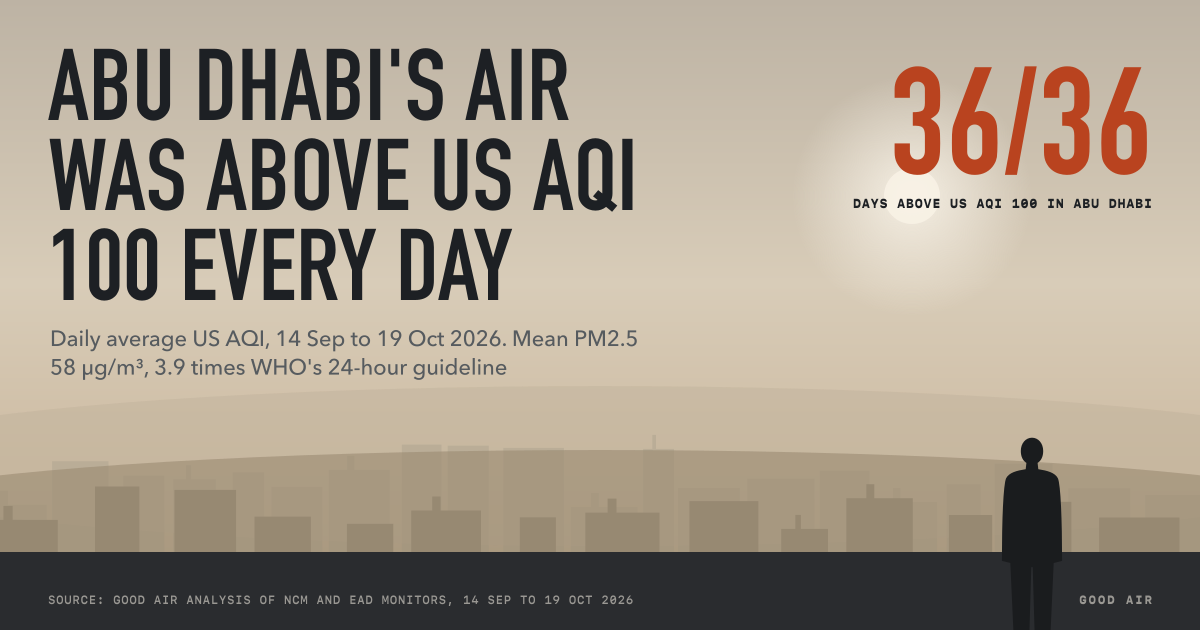
We checked our own archive of NCM and EAD monitors. On the six fog-alert days, daily PM2.5 was higher than on the other 34 days from 14 September to 23 October 2026 in three of the five inland areas we looked at:
| Area | PM2.5 on fog-alert days | PM2.5 on other days |
|---|---|---|
| Abu Dhabi | 64 µg/m³ | 56 µg/m³ |
| Sweihan | 46 µg/m³ | 33 µg/m³ |
| Al Ain | 41 µg/m³ | 31 µg/m³ |
| Liwa | 42 µg/m³ | 36 µg/m³ |
| Madinat Zayed | 25 µg/m³ | 25 µg/m³ |

Al Ain is the clearest case: PM2.5 was above its median on all six fog-alert days, and its daily US AQI averaged 120 against 92. Sweihan's gap comes mostly from 26 September and 6 October, and Liwa's from one day, 6 October, at 131 µg/m³. Madinat Zayed showed no difference.
Hour by hour, the Khalifa City A monitor in Abu Dhabi had higher PM2.5 between midnight and 9 am than between noon and 6 pm on every day from 16 to 23 October. Its morning average was 69 to 105 µg/m³ from 16 to 19 October, which includes the three alert mornings, and 42 to 50 µg/m³ from 20 to 23 October.
This is a hint, not proof. Six days is a small sample, an alert does not mean fog formed at each monitor, and calm mornings raise PM2.5 with or without fog. We also cannot tell whether there was more pollution or whether humid air changed how the monitors read. For Abu Dhabi's longer picture, see our UAE air quality by city analysis.
Does Good Air show UAE fog alerts?
Not yet. Good Air's weather alerts come from India's IMD and the US National Weather Service, not NCM. For fog, follow NCM and Abu Dhabi and Dubai Police. Good Air does show live UAE air quality from government monitors on the UAE page and city pages. Dubai has no government monitor in the feeds we collect, so our Dubai page points to the nearest reading.
How we measured
- Fog-alert days. The six mornings in the table above, each confirmed in a dated news report of an NCM alert: 26 and 30 September and 6, 16, 17 and 18 October 2026. "Other days" are the remaining 34 days from 14 September to 23 October. A day without a reported alert may still have had fog somewhere.
- Air data. Daily PM2.5 averages from the Good Air archive of NCM and EAD monitors, midnight to midnight UTC (4 am to 4 am UAE time), days with at least 12 hourly readings. NCM values look like running 24-hour averages, which smooth short spikes. Hourly figures come from EAD's Khalifa City A monitor, which changes hour by hour. We left out the Al Mafraq monitor because its hourly pattern rises sharply and then settles on the same value for hours, which looks processed.
Frequently asked questions
When is fog season in the UAE?
UAE fog season runs from about September to March. A 36-year study at Abu Dhabi International Airport found December and January had the most fog, with about 24 fog days a year on average. NCM names December, January and February as the foggiest months. In 2026, fog alerts began early, with at least six alert mornings between 26 September and 18 October.
What does a red fog alert mean in the UAE?
A red alert from the National Centre of Meteorology means be extremely vigilant, because hazardous weather of exceptional severity is forecast. Yellow means take care and stay alert to changing conditions. Fog means visibility below 1,000 metres, and fog alerts often come as red and yellow together for different areas. NCM's map shows which areas are under each colour.
What is the speed limit in Abu Dhabi during fog?
When fog forms, Abu Dhabi Police usually lower limits on affected roads to 80 km/h, shown on electronic signboards. The reduced limit overrides the normal one. Exceeding it by up to 10 km/h costs Dh300, doubled for up to 20 km/h over. On 18 October 2026 the 80 km/h limit applied to eight road sections, including Sweihan Road and the Abu Dhabi–Al Ain Road.
Is it illegal to use hazard lights in fog in the UAE?
Driving with hazard lights on is fined Dh500 and four black points, because it stops other drivers seeing when you change lanes. Use low beams or fog lights while moving. Abu Dhabi Police say to switch hazard lights on only after you have pulled over to a safe place off the road.
Does fog affect air quality in Abu Dhabi?
Fog forms in calm, stable air, which can also hold pollution near the ground. In Good Air's data for 14 September to 23 October 2026, Abu Dhabi's PM2.5 averaged 64 µg/m³ on six fog-alert days against 56 on other days, and Al Ain's 41 against 31. The sample is small. Check Abu Dhabi's live AQI for today.