Seasonal · 6 min read
Diwali 2026 and air pollution: firecracker rules and how to protect your family
Diwali is on 8 November 2026. Green crackers are allowed in Delhi NCR on 7 and 8 November at set hours. GRAP Stage 3, past AQI and how to stay safe.
 By the Good Air teamUpdated · First published 14 October 2026
In this article · 5 sections
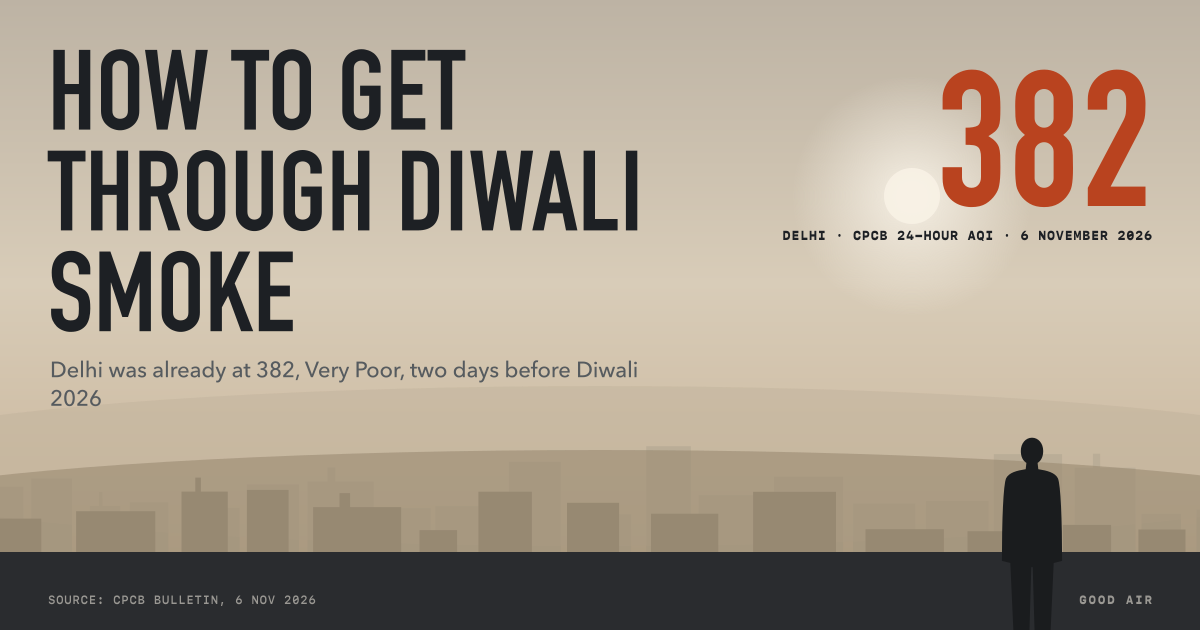
Diwali falls on Sunday, 8 November 2026. In Delhi NCR the Supreme Court allows certified green crackers on 7 and 8 November only, from 6 to 7 am and 8 to 10 pm, and the full ban returns on 9 November (ThePrint/PTI, 2 November). The air is already bad: CPCB put Delhi's 24-hour average AQI at 382 (Very Poor) on 6 November, and CAQM invoked GRAP Stage 3 the same day as a precaution.
For Delhi and much of North India, Diwali lands in the middle of the season when cold, still air traps pollution close to the ground. Fireworks on the night add a short, sharp spike of fine particles and metal-laden smoke. This guide covers what is decided about firecrackers so far, what happened to the air after Diwali in past years, and practical steps to protect your family.
Latest, 7 November 2026
- Green crackers are allowed today and tomorrow. The Supreme Court's order of 29 October, made public on 2 November, permits them in Delhi NCR on 7 and 8 November in two slots, 6 to 7 am and 8 to 10 pm. The rules are below.
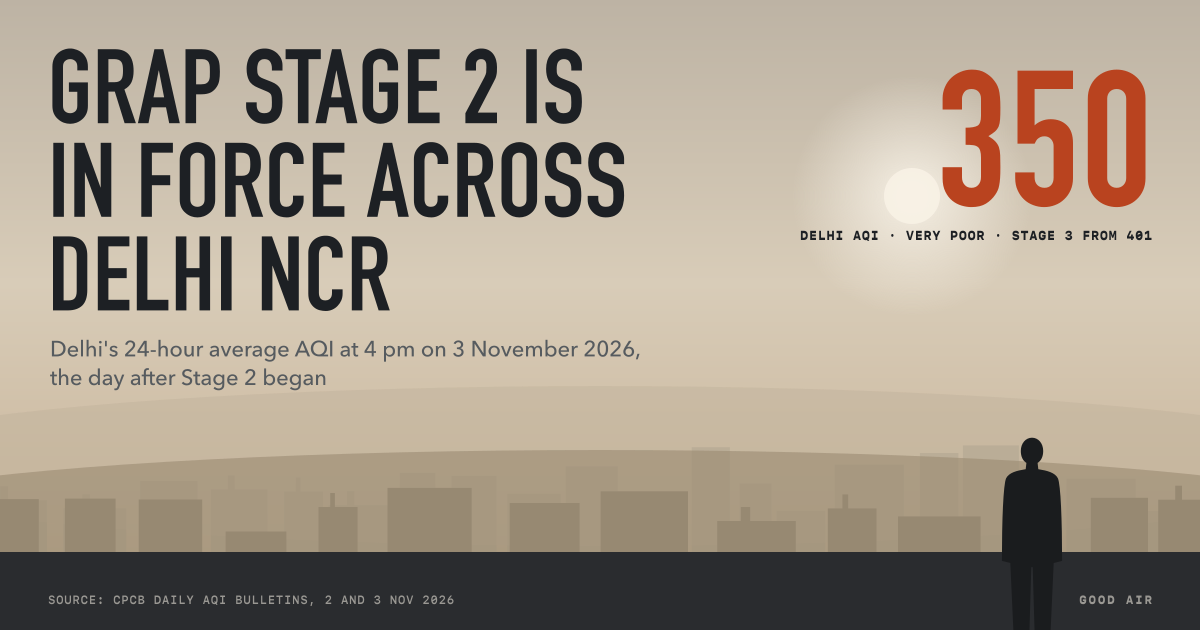
- GRAP Stage 3 is in force. CAQM, the Commission for Air Quality Management, invoked it on 6 November as "a precautionary measure" (Bilkul Online, 6 November), because the forecast from IITM, the Indian Institute of Tropical Meteorology, showed Delhi could reach Severe from 7 to 9 November (Business Today, 6 November). It came four days after Stage 2. What Stage 3 bans covers cars, building work and schools.
- Delhi's air on 6 November: 382, Very Poor, on CPCB's 4 pm bulletin, a 24-hour average from 57 of 59 stations. Gurugram was 368, Faridabad 313, Noida 303 and Ghaziabad 257 (CPCB bulletin, 6 November).
- Delhi's air this morning: Good Air's live page read Delhi at an India NAQI of 419 (Severe) at 10 am IST on 7 November, from 58 stations. Our figure is an hourly reading, so it is not directly comparable with CPCB's 24-hour bulletin (Delhi live AQI).
- Outside Delhi NCR: district orders vary. On 22 October, Kangra district in Himachal Pradesh allowed only green crackers and limited bursting on Diwali night to 8 pm to 10 pm, with sales only under permits from the Sub-Divisional Magistrate (The Chenab Times, 22 October).
Firecracker rules for Diwali 2026
A bench of Justices M.M. Sundresh and Prasanna B. Varale set the rules for Delhi NCR in an order dated 29 October 2026 (ThePrint/PTI, above). The main terms, from LiveLaw, 2 November and PTI:
- When: 7 and 8 November, from 6 to 7 am and 8 to 10 pm. LiveLaw words the hours differently; PTI and Open give these two slots.
- What: only green crackers approved by CSIR-NEERI, the national environmental engineering institute, in sealed boxes with a batch-specific QR code. Crackers containing barium and joined "ladis" or garlands are not allowed.
- Where to buy: only at places named by the district authorities, and not online. Licences of traders whose licences had been cancelled were restored for 4 to 6 November.
- Where not to burst: within 300 metres of hospitals, nursing homes, health centres, old-age homes, notified silence zones and educational institutions.
- Enforcement: police patrols, vehicle checks at the NCR's entry points and seizure of illegal crackers. CPCB and the state boards must report air quality daily through 30 November.
- After Diwali: the complete ban returns on 9 November 2026.
What happened last year: in October 2025, the Supreme Court relaxed the Delhi NCR ban for Diwali, allowing green crackers approved by NEERI to be sold through designated sellers and burst between 18 and 21 October within fixed time slots (LawBeat, 12 October 2026). This year's window is shorter, two days instead of four.
Outside Delhi NCR, courts and state governments have often limited sales to green crackers and bursting to a short window on Diwali night, usually 8 pm to 10 pm. Kangra in Himachal Pradesh has done so for 2026 (see Latest above). Check your own district's order. Our Delhi air pollution tracker will carry hourly readings from the evening of 8 November.
What fireworks do to the air
Firecrackers release fine particles (PM2.5 and PM10), sulphur dioxide and metals such as barium, strontium, copper and aluminium, which give fireworks their colours. On a calm winter night these stay close to the ground.
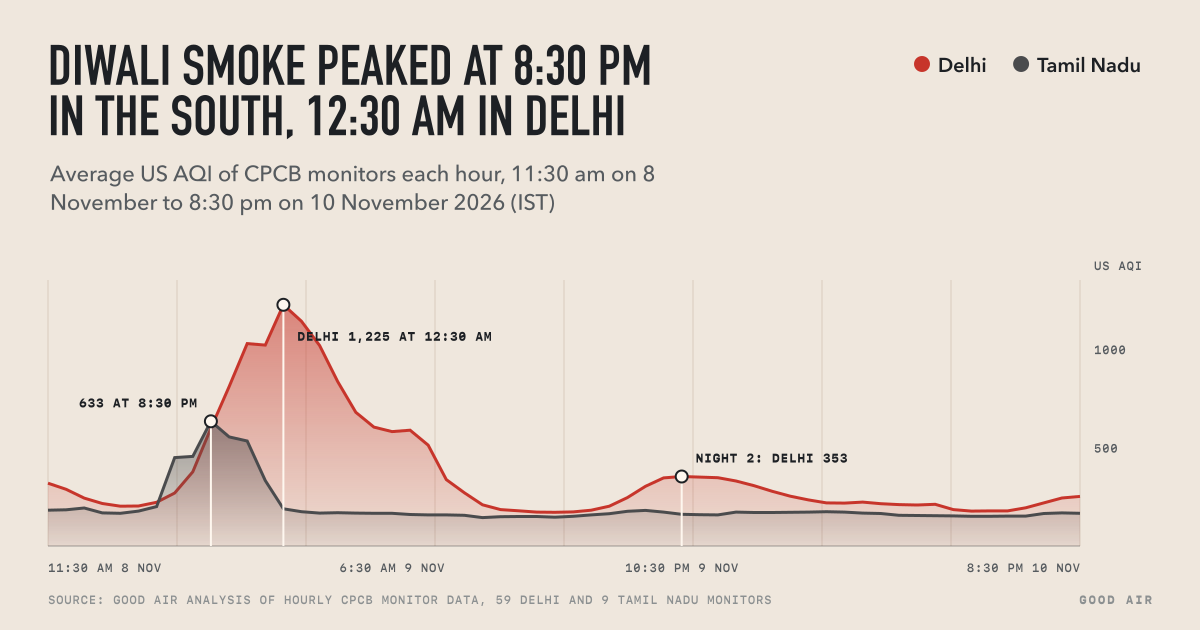
In Delhi, the hourly PM2.5 readings on Diwali night and the following morning are typically among the highest of the year. The effect fades over one to two days if the wind picks up, but it adds to a baseline that is already high.
What Diwali did to Delhi's air in past years
CPCB's daily bulletin gives each city's AQI at 4 pm as an average of the previous 24 hours. Here is Delhi on Diwali and the day after in the last three years:
| Year | Diwali | AQI on Diwali (4 pm) | AQI the day after |
|---|---|---|---|
| 2025 | 20 October | 345 (Very Poor) | 351 (Very Poor) |
| 2024 | 31 October | 328 (Very Poor) | 339 (Very Poor) |
| 2023 | 12 November | 218 (Poor) | 358 (Very Poor) |
Sources: CPCB bulletins for 20 and 21 October 2025, 31 October and 1 November 2024, 12 and 13 November 2023.
Because the bulletin is a 24-hour average taken at 4 pm, most of the Diwali-night smoke shows up in the next day's figure. In 2023, Delhi went from 218 on Diwali to 358 the next day, the largest overnight jump of the three years. In 2025, even with green crackers allowed only in fixed time slots, the AQI stayed above 340 on Diwali and both following days (353 on 22 October 2025, CPCB). This year Delhi starts high: 382 on 6 November, two days before Diwali, is already above the Diwali-day figure in any of those three years.
The health effects are immediate for some people: coughing, wheezing and asthma attacks, irritated eyes, and a higher risk of heart attacks in people with heart disease. Smoke and noise also distress pets and street animals.
How to protect your family
The essentials are below. For an hour-by-hour plan, a clean room and when to see a doctor, see how to protect yourself from Diwali pollution.

Before Diwali
- If someone at home has asthma or COPD, check their inhaler and medicine supply and their action plan with a doctor.
- Get well-fitting N95 or FFP2 masks, including child sizes.
- If you have an air purifier, change or clean the filter.
On the night
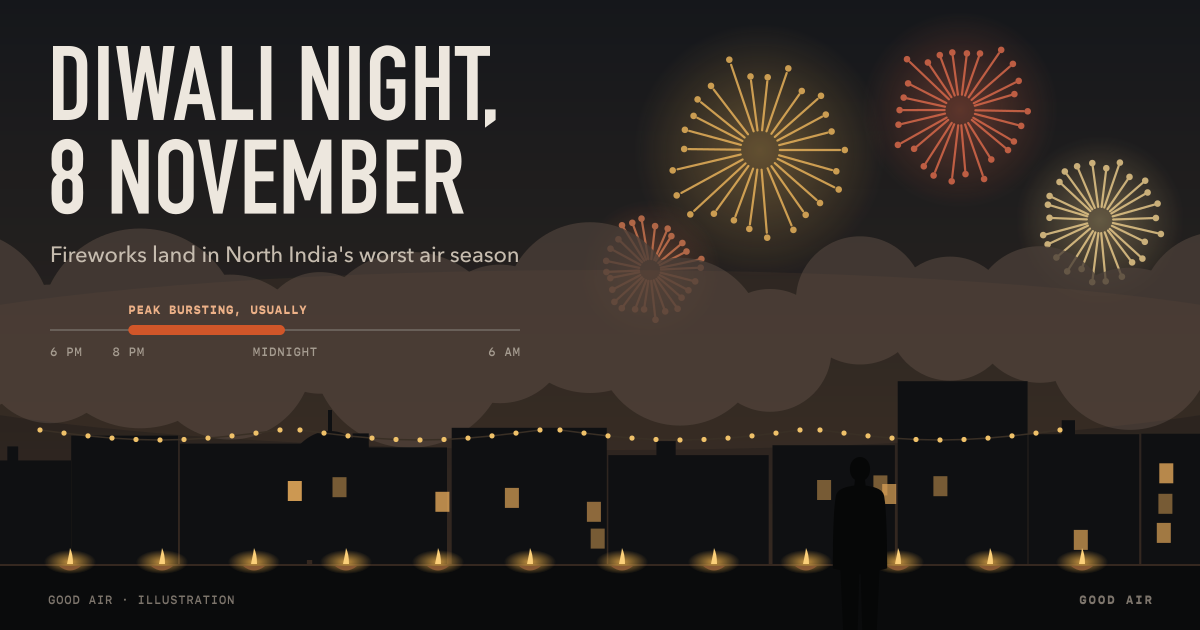
- Keep children, older relatives and anyone with heart or lung conditions indoors during the peak hours of bursting, usually 8 pm to midnight.
- Close doors and windows and run an air purifier in the room where vulnerable family members will sleep.
- If you do go out, wear an N95 or FFP2 mask and stand back from the bursting area.
- Choose quieter ways to celebrate: diyas, lights, rangoli, and community displays instead of firing crackers at home.
The morning after
- Don't rush to open windows or go for a morning walk; the air often stays bad until late morning. Check the live AQI for your city first.
- Postpone outdoor exercise until the reading falls back.
- If you want to air the house, the early afternoon is usually the cleanest time; our hourly data for Delhi NCR shows why.
- A dry cough or sore throat after a smoky night is common; see what helps a pollution cough and when to see a doctor.
Frequently asked questions
When is Diwali in 2026?
Diwali, Lakshmi Puja, is on Sunday, 8 November 2026.
Are firecrackers banned in Delhi for Diwali 2026?
Not completely. The Supreme Court allows certified green crackers in Delhi NCR on 7 and 8 November 2026, from 6 to 7 am and 8 to 10 pm. All other firecrackers stay banned, and the complete ban returns on 9 November. In 2025 the court allowed green crackers for four days in fixed time slots.
What are green crackers?
Firecrackers made to a formulation certified by CSIR-NEERI that cuts particulate emissions and avoids some of the most harmful chemicals, such as barium nitrate. They pollute less than conventional crackers but still pollute.
What was Delhi's AQI after Diwali last year?
On 21 October 2025, the day after Diwali, CPCB's 24-hour average for Delhi was 351, Very Poor. It was 345 on Diwali itself and 353 the day after that. In 2024 the day-after figure was 339, and in 2023 it was 358.
Is GRAP in force in Delhi before Diwali 2026?
Yes, and at Stage 3. CAQM invoked Stage 1 on 21 October, Stage 2 on 2 November and Stage 3 on 6 November 2026, the last as a precaution with Delhi at 382 and Severe air forecast from 7 to 9 November. Check the Delhi air pollution tracker for changes.
How long does Diwali pollution last?
The sharpest spike is usually on the night and the next morning. It typically eases over one or two days if winds pick up, but on calm, cold days it can merge with the wider winter smog.