
Worst now
Delhi NCR air pollution: live tracker
CAQM revoked GRAP Stage III on 17 November with Delhi's 24-hour AQI at 204; Stages I and II stay in force, and so does the 30 October order on construction dust
Updated · CPCB
Live air quality across Delhi and the NCR from CPCB monitors, the current GRAP stage, and what to expect this week.
Live tracker · Story updated 20 November 2026
- Delhi NCR: 19 of 21 cities Unhealthy or worse, worst Karnal US AQI 267 (Very Unhealthy)
- Most polluted in North India: 58 of 70 cities Unhealthy or worse, worst Jalandhar US AQI 638 (Hazardous)
Live data updated 7:00 pm UTC.
Delhi NCR
- Unhealthy for Sensitive Groups 2
- Unhealthy 12
- Very Unhealthy 7
- 267KarnalHaryana · Very Unhealthy
- 254BhiwadiVery Unhealthy
- 231GurugramHaryana · Very Unhealthy
- 229GhaziabadUttar Pradesh · Very Unhealthy
- 224PanipatHaryana · Very Unhealthy
- 219DelhiVery Unhealthy
- 216MeerutUttar Pradesh · Very Unhealthy
- 197Greater NoidaUttar Pradesh · Unhealthy
- 192BahadurgarhUnhealthy
- 191BulandshahrUnhealthy
Show all 21 cities
- 188NoidaUttar Pradesh · Unhealthy
- 183BaghpatUnhealthy
- 183MuzaffarnagarUttar Pradesh · Unhealthy
- 181RohtakHaryana · Unhealthy
- 178SonipatHaryana · Unhealthy
- 172HapurUnhealthy
- 166FaridabadHaryana · Unhealthy
- 166JindUnhealthy
- 162AlwarRajasthan · Unhealthy
- 147Charkhi DadriUnhealthy for Sensitive Groups
- 139PalwalUnhealthy for Sensitive Groups
US AQI from State & Central Pollution Control Board, Government of India · Center for Study of Science, Technology and Policy (CSTEP) · Aurassure's University Clean Air Network · Updated 12:30 am IST · All India cities →
Most polluted in North India
- Moderate 2
- Unhealthy for Sensitive Groups 10
- Unhealthy 44
- Very Unhealthy 12
- Hazardous 2
- 638JalandharPunjab · Hazardous
- 342LudhianaPunjab · Hazardous
- 267KarnalHaryana · Very Unhealthy
- 247BhopalMadhya Pradesh · Very Unhealthy
- 241SingrauliMadhya Pradesh · Very Unhealthy
- 231GurugramHaryana · Very Unhealthy
- 229GhaziabadUttar Pradesh · Very Unhealthy
- 224PanipatHaryana · Very Unhealthy
- 222UdaipurRajasthan · Very Unhealthy
- 216MeerutUttar Pradesh · Very Unhealthy
- 213KanpurUttar Pradesh · Very Unhealthy
- 208AmbalaHaryana · Very Unhealthy
US AQI from State & Central Pollution Control Board, Government of India · Center for Study of Science, Technology and Policy (CSTEP) · Aurassure's University Clean Air Network · Updated 12:30 am IST · All India cities →
GRAP status
GRAP Stage II is in force across the NCR, on top of Stage I. CAQM's GRAP sub-committee revoked Stage III on 17 November 2026, with Delhi's 24-hour AQI at 204 and IMD and IITM forecasting Poor to Very Poor air in the coming days (PIB, 17 November). Stage III had applied since 6 November, invoked as a precaution before Diwali (Business Today, 6 November). Stage II has applied since 2 November and Stage I since 21 October. CAQM's separate order of 30 October restricting dust-raising demolition and outdoor construction across the NCR stays in force, apart from exempted projects, and agencies were told to tighten Stage I and II measures so Stage III need not return (PIB, 17 November). What Stage II means · what Stage III banned.
What Stage III added from 6 to 17 November: no BS-III petrol or BS-IV diesel four-wheelers in Delhi, Gurugram, Faridabad, Ghaziabad, Gautam Buddh Nagar and Sonipat; a ban on non-essential construction and demolition; stone crushers and mining shut; hybrid classes up to Class 5, with parents choosing; and offices can be told to work at 50% attendance (The Pioneer, 6 November; Indian Opinion, 7 November).
Stage II, still in force, added higher parking fees, staggered office hours in Delhi, Gurugram, Faridabad, Ghaziabad and Gautam Buddh Nagar, more road sweeping and water sprinkling, more Metro and bus services, and electric heaters from resident welfare associations for guards and other staff so they don't light fires (Asianet Newsable, 2 November; India TV, 2 November).
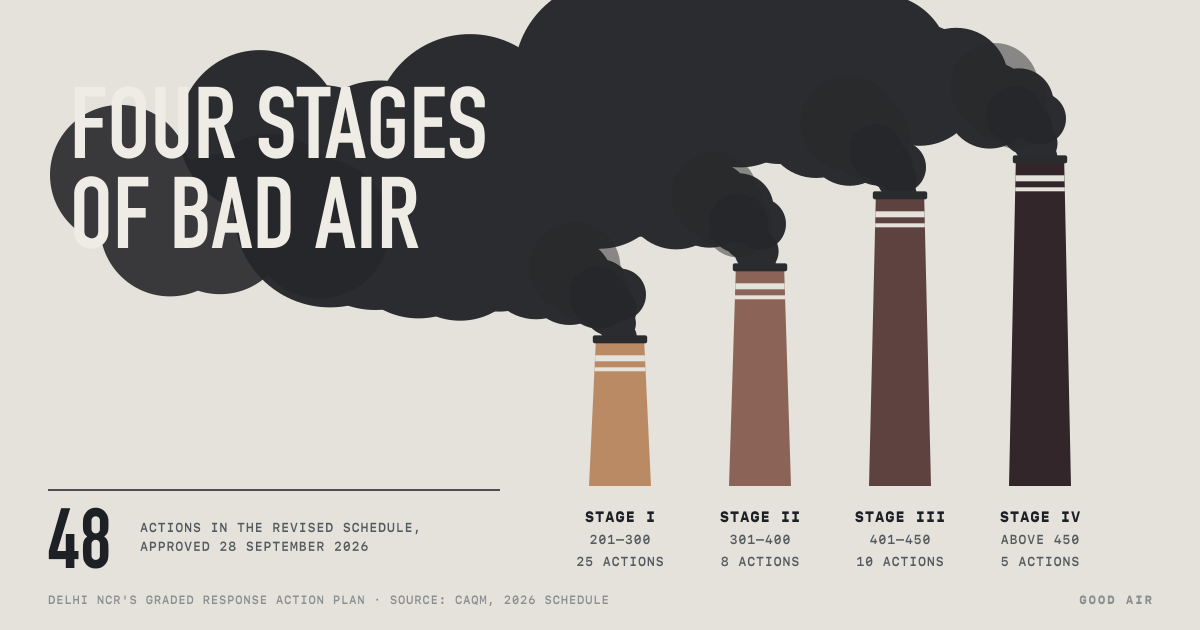
GRAP stages follow CPCB's daily average on India's NAQI, not the hourly US AQI readings above, which can run far higher at night. Stage I applies from NAQI 201 (Poor), Stage II from 301 (Very Poor), Stage III from 401 (Severe) and Stage IV above 450. What each GRAP stage does.
Diwali week: what happened
Diwali was on Sunday 8 November. Delhi's 24-hour AQI on India's NAQI went 376 on Diwali day, 344 the day after and 299 on 10 November, so the festival passed without a Severe day (CPCB, 10 November). What we wrote before it:
- No rain in sight. IMD's Delhi forecast shows no rain, mainly clear skies and morning mist every day to 9 November, with light north-westerly winds of 5 to 20 km/h turning south-easterly on Diwali day (IMD New Delhi, 3 November, 8:45 pm). In October, it was rain that cleaned Delhi's air, each time for only a day or two (our analysis).
- Green crackers for two days. The Supreme Court allows certified green crackers on 7 and 8 November, from 6 to 7 am and 8 to 10 pm only. Production is allowed from 2 to 6 November and sales only at designated places, not online. Barium crackers and series crackers stay banned, and the full ban returns on 9 November (Courtbook, 2 November; The Week, 2 November).
- Farm fires at their peak. Punjab had its most fires of the season on 31 October (292) and had logged 1,612 by 2 November (The Tribune, 2 November). How much smoke reaches Delhi depends on the wind.
Diwali night, hour by hour: our Diwali AQI tracker and the Diwali 2026 pollution map. How to protect yourself on smoky days.
Latest
- 17 November: GRAP Stage III revoked. CAQM lifted Stage III across Delhi NCR with immediate effect after Delhi's 24-hour AQI fell to 204 (Poor). Stages I and II continue, as does the 30 October order on dust-raising construction and demolition (PIB, 17 November). Older BS-III petrol and BS-IV diesel cars may run again, and schools no longer have to offer hybrid classes under GRAP.
- 16 November, 10 am: The smog came back overnight. Sunday's clean afternoon lasted a few hours. Across Delhi's monitors our hourly reading went from US AQI 76 at 3 pm on 15 November to 495 at 7 am on 16 November (India's NAQI 55 to 430), and PM2.5 from 22 to 323 µg/m³, about 15 times higher in 16 hours. At 7 am Gurugram read NAQI 434, Noida 373, Faridabad 347 and Ghaziabad 333. These are single-hour readings: the windless night traps smoke near the ground (why the air is worst at night). GRAP follows CPCB's 24-hour figure, which comes out at 4 pm. The forecast quoted by PTI: Poor today with moderate fog, then Very Poor from 17 November for about six days, as the ventilation index falls from 16,000 on 15 November to 6,000 on 18 November; below 6,000 with winds under 10 km/h, smoke does not disperse (ThePrint with PTI, 15 November).
- 15 November: Delhi improves to 290 (Poor) in CPCB's 4 pm bulletin, after four Very Poor days; Gurugram 296, Sonipat 297, Bahadurgarh 267, Noida 265, Faridabad 257 and Ghaziabad 243, all Poor (CPCB, 15 November). IMD recorded drizzle at several places and south-westerly winds up to 15 km/h. Biomass burning made up 37.1% of Delhi's PM2.5 that day, the largest share (ThePrint with PTI, 15 November). On our hourly data Delhi was cleanest at 3 pm, US AQI 76.
- 11 to 14 November: Four Very Poor days, none Severe. Delhi's 24-hour AQI: 313 on 11 November, 350 on 12 November, 373 on 13 November and 367 on 14 November. Ballabgarh reached 400 on 13 November, one point below Severe; on 14 November Bahadurgarh read 376, Meerut 367, Faridabad 347, Hapur 341, Gurugram 340, Ghaziabad 333 and Noida 318 (CPCB, 11, 12, 13 and 14 November). Hourly readings went higher: on our data Delhi stayed above NAQI 400 from 10 pm on 13 November to 3 am on 14 November.
- 11 November: No Severe day over Diwali. CPCB's 4 pm bulletin put Delhi at 344 (Very Poor) on 9 November, the day after Diwali, below Diwali day's 376; Bahadurgarh came closest to Severe at 400, with Faridabad 350, Gurugram 345, Noida 332 and Ghaziabad 324 (CPCB, 9 November). On 10 November Delhi fell to 299 (Poor), its first Poor day since 1 November; Noida 301 and Gurugram 323 stayed Very Poor (CPCB, 10 November). Nine Diwalis compared: Delhi AQI after Diwali 2026. We found no CAQM order revoking Stage III by 11 November.
- 9 November, 11:30 IST: The smoke peaked after midnight. Across Delhi's reporting monitors the median US AQI rose from 292 at 7:30 pm to 1,398 around 12:30 am, and was still 466 (Hazardous) at 7:30 am; 56 of 59 NCR monitors passed 500 in at least one hour. CPCB's Sameer app showed 368 (Very Poor, India's 24-hour NAQI) at 7:05 am (ETV Bharat, 9 November). Hour by hour and monitor by monitor: Delhi AQI after Diwali 2026. The full cracker ban returns today.
- 8 November, 10 pm: After the 8 to 10 pm cracker window, Delhi reads US AQI 648 (Hazardous; India's NAQI 460, Severe) on our live page, an hourly reading from 59 monitors; 33 Delhi monitors are above 500. Noida 909, Ghaziabad 817, Faridabad 552, Gurugram 380. From tonight this tracker, like the Good Air app, shows the US AQI first; CPCB bulletin figures and GRAP thresholds stay on India's NAQI.
- 8 November: Diwali. CPCB's 4 pm bulletin puts Delhi at 376 (Very Poor), up from 369 on 7 November; only Diwali 2020 (414) and 2021 (382) started worse since 2018 (CPCB). Hour-by-hour updates through Diwali night and the two days after, for Delhi NCR and every big Indian city, are on our Diwali AQI live tracker.
- 7 November: Our live page reads Delhi at an India NAQI of 419 (Severe) at 10 am IST from 58 stations. That is an hourly reading, not comparable with CPCB's 24-hour bulletin. The Supreme Court's green-cracker window opens today.
- 6 November: CAQM invokes GRAP Stage III across Delhi NCR as a precaution (Business Today, 6 November). CPCB's 4 pm bulletin: Delhi 382 and Gurugram 368, Faridabad 313 and Noida 303, all Very Poor; Ghaziabad 257, Poor (CPCB, 6 November). Jahangirpuri reads 449, DTU 445 and Bawana 428 at 4 pm.
- 5 November: Delhi 369 (Very Poor), Gurugram 331, Faridabad 303; Noida 283 and Ghaziabad 263, Poor (CPCB).
- 4 November: Delhi 377 (Very Poor), Noida 330, Gurugram 322; Ghaziabad 257, Poor; Faridabad 160, Moderate (CPCB).
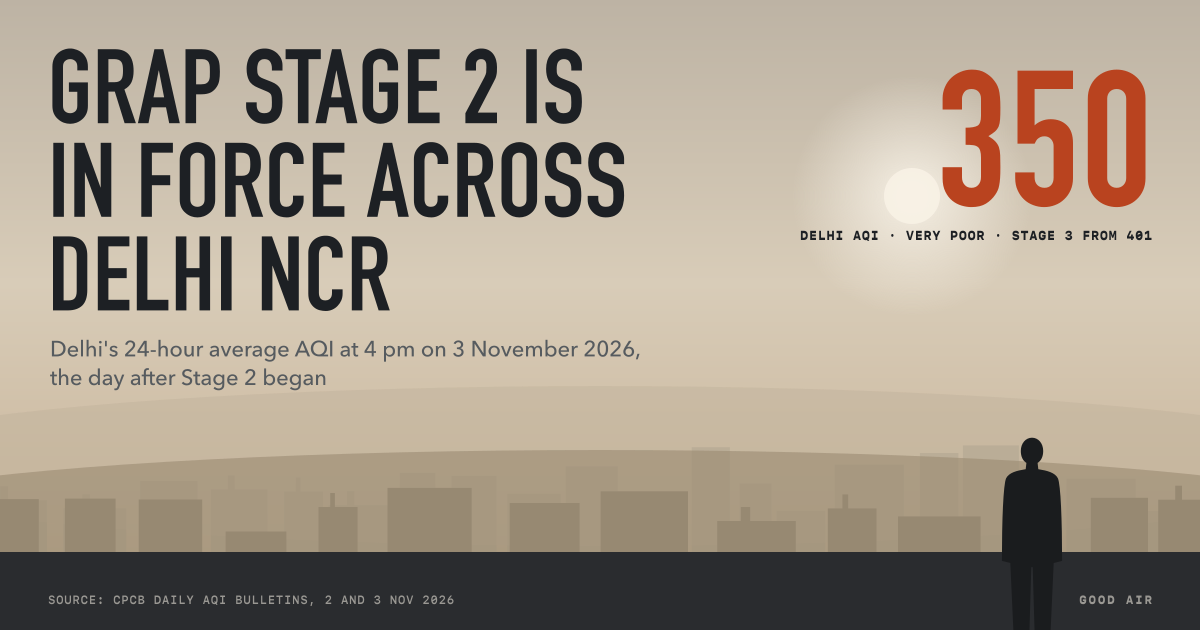
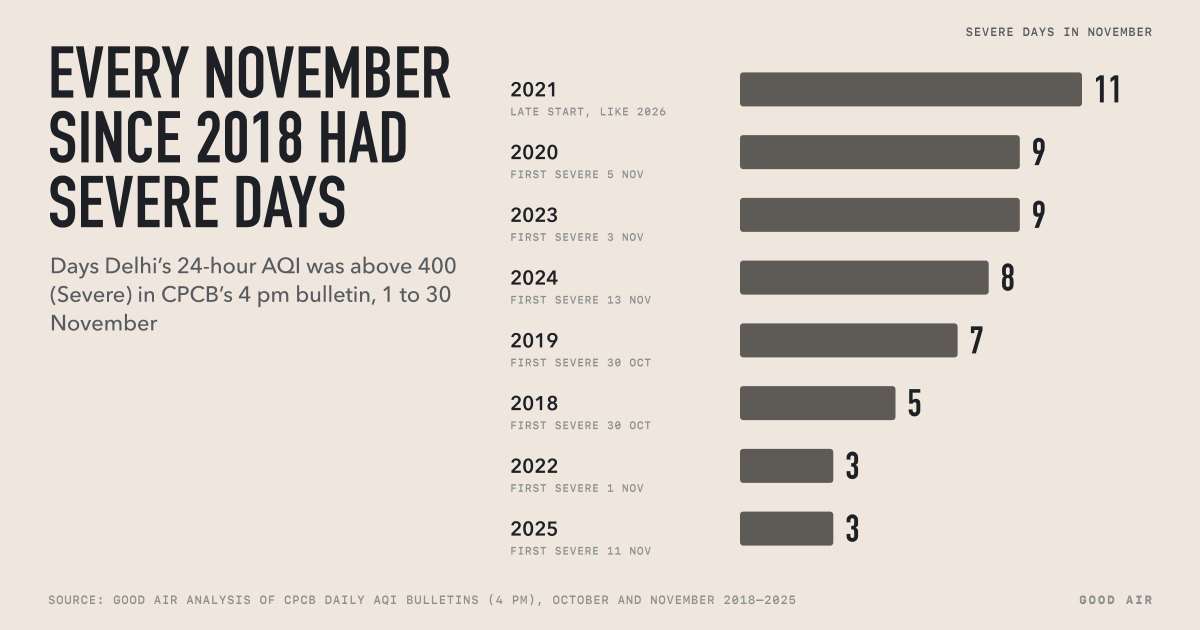
- 3 November: Delhi's 24-hour AQI rises to 350 (Very Poor) in CPCB's 4 pm bulletin, from 324 a day earlier. Baghpat (360), Bahadurgarh (324), Ballabgarh (319), Manesar (309) and Gurugram (305) are also Very Poor; Noida (291) and Ghaziabad (235) improve to Poor, Greater Noida (189) and Faridabad (106) to Moderate (CPCB). On 2 November Jahangirpuri reached 436, Rohini 415 and Punjabi Bagh 413 (India.com). Every November since 2018 has had Severe days (our data).
- 2 November: CAQM invokes GRAP Stage II across Delhi NCR. CPCB's 4 pm bulletin: Noida 330 and Delhi 324, both Very Poor; Ghaziabad and Greater Noida 289, Gurugram 246, Poor; Sonipat 161 and Faridabad 115, Moderate (CPCB; ETV Bharat).
- 2 November: Punjab's farm fire count for the season reaches 1,612, with 98 fires on 2 November and 175 the day before. Tarn Taran leads with 489. As of 1 November, Rajasthan had 671, Madhya Pradesh 566, Uttar Pradesh 345 and Haryana 42 (The Tribune).
- 2 November: The Supreme Court's 29 October order on Diwali crackers is made public: green crackers only, on 7 and 8 November, 6 to 7 am and 8 to 10 pm (The Week). Diwali 2026 rules.
- 1 November: Delhi's AQI jumps to 261 (Poor), from 117 the day before (CPCB). Delhi's Winter Action Plan ban on dust-generating demolition and outdoor construction starts and runs to 31 January (Asianet Newsable, 29 September). Petrol and diesel vehicles registered outside Delhi that are not BS-VI are barred from entering until 31 January, with exemptions for CNG and electric vehicles; check Delhi Traffic Police for the exact terms (India TV, 2 November).
- 30 October: After the rain and wind IMD had forecast for 29 and 30 October, Delhi's AQI falls to 60 (Satisfactory), from 222 the day before (CPCB, 30 October; CPCB, 29 October). It was back at 117 on 31 October (CPCB). What rain does to Delhi's air.
- 28 October: IMD forecasts rain on 29 and 30 October, then dry days; Delhi's AQI is 229 (our report). October 2026 ended as Delhi's cleanest October since at least 2018 (our analysis).
- 22 October: At 8 am, 36 of the 71 NCR monitors reporting had an hourly India NAQI above 300; Vasundhara in Ghaziabad was highest at 424. These are single-hour readings, not the 24-hour average GRAP uses (area pages).
- 21 October: CAQM invokes GRAP Stage I across Delhi NCR. CPCB's 4 pm bulletin: Delhi 245, Greater Noida 280, Noida 249, Ghaziabad 223, Gurugram 216, all Poor; Faridabad 123 (PIB; CPCB).
- 16 October: Our hourly data shows the NCR's air is cleanest from about noon to 5 pm and worst late at night (analysis).
- 13 October: The Centre asks Madhya Pradesh, Rajasthan, Punjab, Haryana and Delhi NCR to fight stubble burning in "mission mode" (India TV with PTI).
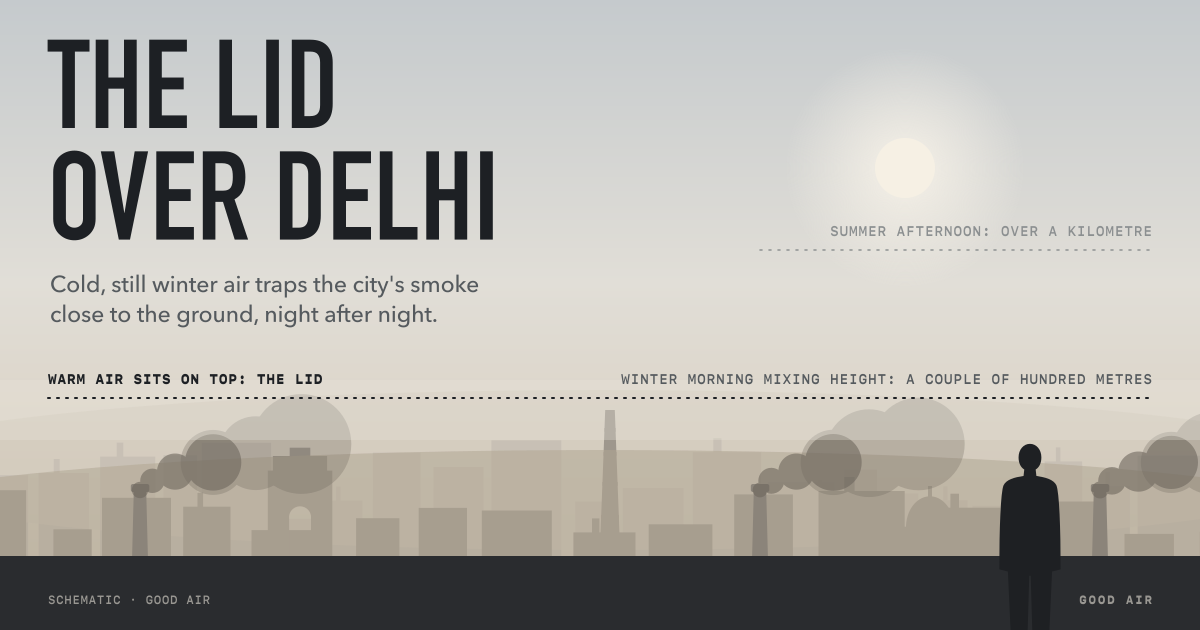
Background: why Delhi's air turns toxic every winter, stubble burning explained and Punjab's farm fires this season.
What to do on a smoggy day
- Check the live reading for your area before going out. Readings across Delhi's stations can differ by over 100 points at the same time.
- Skip dawn walks and runs on smoggy days; early afternoon is usually cleaner.
- Wear a well-fitted N95 or FFP2 mask outdoors when the AQI is Poor or worse.
- Run a HEPA air purifier in bedrooms with windows closed, especially on Diwali night.
- Don't burn anything, and keep your vehicle's PUC certificate valid.
Related reading
 SeasonalWhy Delhi's air turns toxic every winter, and what is being done in 2026
 NewsDelhi NCR moves to GRAP Stage 2 as the air turns Very Poor: the rules, and what comes next
 Data storiesDelhi's smog season started late this year. Every November since 2018 still had Severe days
 ExplainersGRAP explained: what each stage means for Delhi NCR in winter 2026
Frequently asked questions
What is Delhi's AQI today?
The live list above shows every Delhi NCR city's latest reading from CPCB monitors on the US AQI, with India's official National AQI (NAQI) on each city page, updated through the day. GRAP and news reports use CPCB's 24-hour NAQI from the 4 pm bulletin. See all of Delhi's stations.
Is GRAP in force in Delhi today?
Yes. Stage II is in force across the NCR, on top of Stage I. CAQM revoked Stage III on 17 November 2026, 11 days after invoking it, with Delhi's AQI at 204. The GRAP status section above shows the latest stage we have confirmed; CAQM announces each change on its website and social media.
Will Delhi's air get worse this week?
Probably. The forecast quoted on 15 November is Poor on 16 November, then Very Poor from 17 November for about six days, with the ventilation index falling to 6,000 by 18 November, too low for smoke to clear (ThePrint with PTI). Expect the worst hours late at night and early morning, and the cleanest in the early afternoon.
Why is Delhi's AQI so high in the morning when the official AQI is lower?
The official figure is CPCB's 24-hour average, published at 4 pm. The live readings above are hourly, and on still winter nights smoke builds up near the ground, so the morning hours can read far worse than the day's average. On 16 November Delhi's hourly reading was US AQI 495 at 7 am, while CPCB's figure for the day before was 290.
Which part of NCR has the worst air today?
The Delhi NCR list above ranks Delhi, Noida, Greater Noida, Ghaziabad, Gurugram, Faridabad, Sonipat and neighbouring cities by their current reading, worst first.