Explainers · 6 min read
GRAP explained: what each stage means for Delhi NCR in winter 2026
What Delhi NCR's Graded Response Action Plan does at each stage, from dust control at Stage 1 to truck bans at Stage 4, and what changed in 2026.
 By the Good Air teamUpdated · First published 14 October 2026
In this article · 5 sections
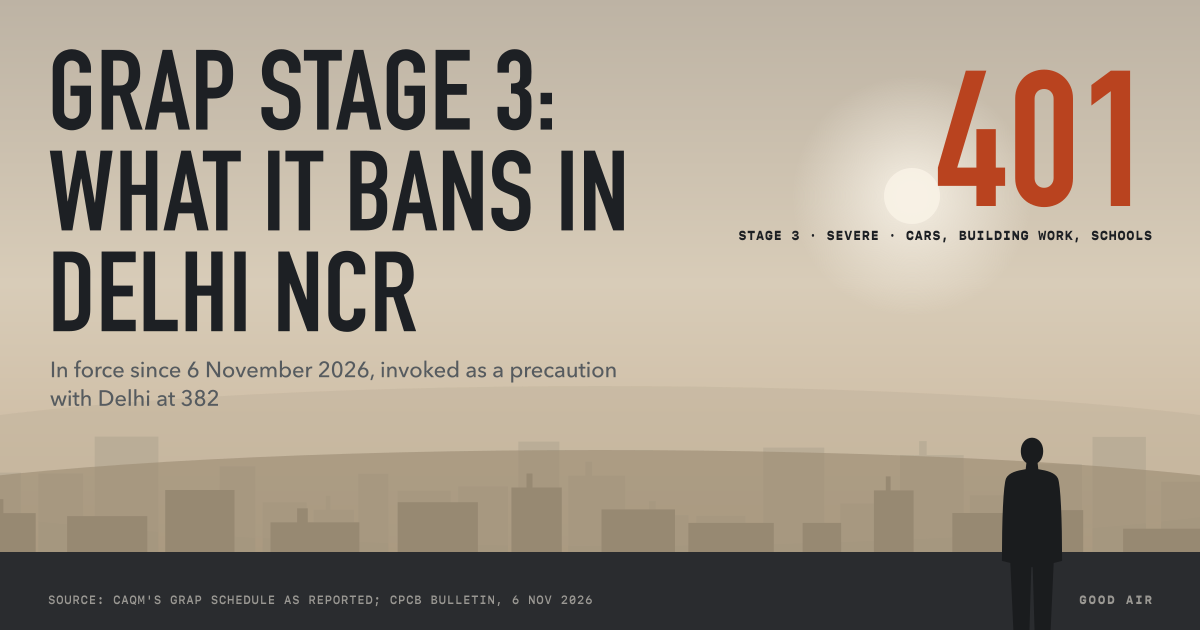
The Graded Response Action Plan (GRAP) is Delhi NCR's emergency playbook for bad air. As of 17 November 2026, GRAP Stage II is in force across the NCR, on top of Stage I: CAQM revoked Stage III that day with Delhi's AQI at 204 (PIB, 17 November). Stage III had been invoked on 6 November as a precaution with Delhi's 24-hour AQI at 382 (Very Poor) and Severe air forecast from 7 to 9 November, on top of Stage II from 2 November and Stage I from 21 October (Business Today, 6 November; CPCB, 6 November). What Stage III bans. As the Air Quality Index climbs, the Commission for Air Quality Management (CAQM) switches on more restrictions, in four stages. Each stage keeps everything from the stages below it.
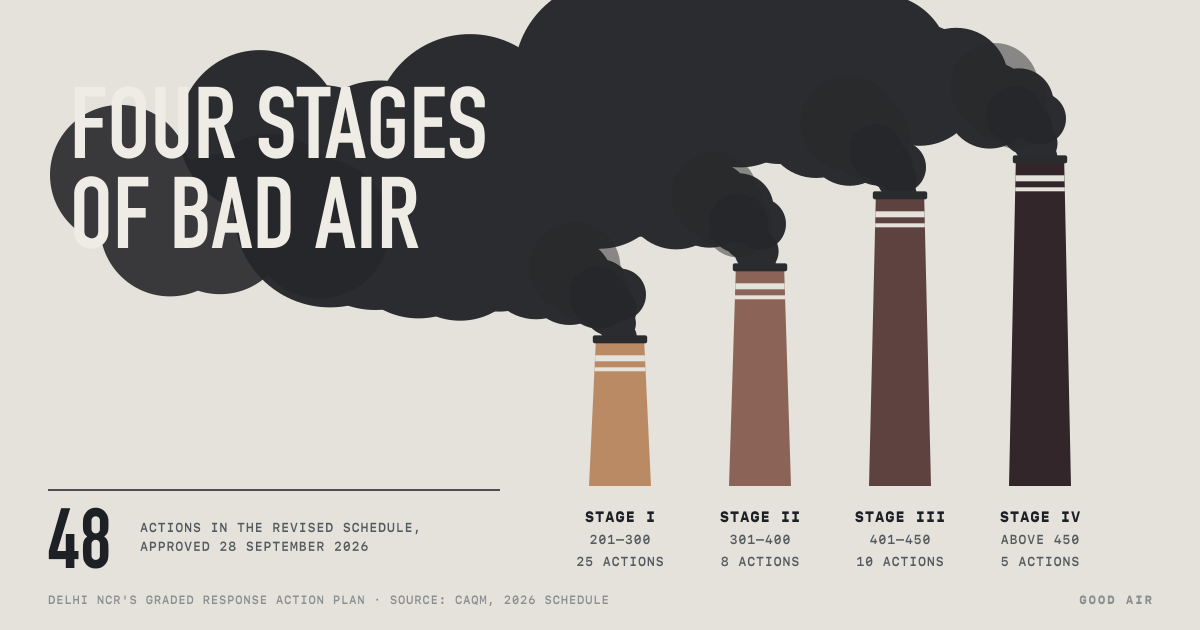
On 28 September 2026, CAQM approved a revised schedule for this winter. It contains 48 actions: 25 at Stage I, 8 at Stage II, 10 at Stage III and 5 at Stage IV (PIB, 29 September). The Delhi air pollution live tracker shows the stage in force today.
The four stages and when they apply
GRAP stages are tied to Delhi's daily average AQI on India's National Air Quality Index, as published in the Central Pollution Control Board's (CPCB) 4 pm bulletin:
| Stage | Delhi AQI | Category |
|---|---|---|
| Stage I | 201 to 300 | Poor |
| Stage II | 301 to 400 | Very Poor |
| Stage III | 401 to 450 | Severe |
| Stage IV | Above 450 | Severe+ |
Sources: CAQM's Stage I order (PIB, 21 October) and reporting of the Stage II order (ETV Bharat, 2 November).

CAQM can also invoke a stage in advance, when forecasts show the AQI is about to cross a threshold. It can revoke a stage once air improves. Stages are not switched on by a single bad hour: the hourly AQI you see on a live map can spike well above the daily average overnight.
GRAP in winter 2026 so far
| Date | Decision | Delhi's AQI that day |
|---|---|---|
| 21 October 2026 | Stage I invoked across the NCR, all 25 actions | 245 (Poor) |
| 2 November 2026 | Stage II invoked across the NCR, on top of Stage I | 324 (Very Poor) |
| 6 November 2026 | Stage III invoked across the NCR as a precaution, on top of Stages I and II | 382 (Very Poor) |
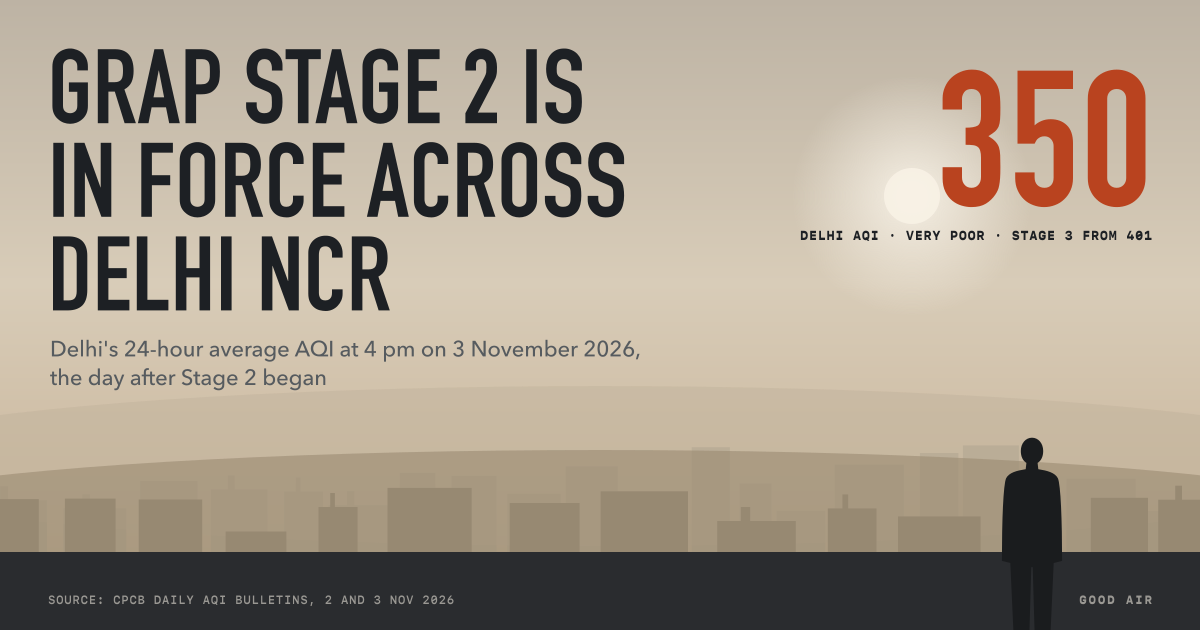
CAQM invoked Stage I when Delhi's daily average reached 244 at 2 pm and 245 at 4 pm on 21 October (PIB, 21 October). Rain then pulled the AQI down to 60 on 30 October (CPCB, 30 October); we found no report that Stage I was revoked. The AQI rose from 117 on 31 October to 261 on 1 November and 324 on 2 November, and CAQM said IMD and IITM forecasts show it staying Very Poor (ETV Bharat, 2 November). Diwali is on 8 November, and IMD forecasts no rain in Delhi up to that day (IMD New Delhi, 2 November). Delhi stayed Very Poor through the week, at 350 on 3 November and 382 on 6 November, when CAQM invoked Stage III ahead of a forecast of Severe air (CPCB, 6 November). Our Delhi tracker has the latest readings.
What each stage does
The exact list is set out in CAQM's order. These are the main measures, with this year's changes marked.
Stage I: Poor (AQI 201 to 300)
Stage I is about enforcing rules that should apply anyway, plus some early curbs.
- Dust control at construction and demolition sites, with fines for violations. Sites of 500 square metres or more must be registered on their state's web portal; new in 2026, this also covers eligible sites beyond municipal limits, such as industrial areas and highway corridors (PIB, 29 September).
- Bans on open burning of waste and biomass, and enforcement of Pollution Under Control (PUC) certificates for vehicles.
- Moved to Stage I in 2026: curbs on diesel generator sets, and a ban on BS-IV and older buses entering Delhi. Electric, CNG and BS-VI buses are exempt.
- Mechanised road sweeping and water sprinkling on dusty roads.
Stage II: Very Poor (AQI 301 to 400)
- More frequent road cleaning, water sprinkling and anti-smog guns at hotspots.
- More metro and electric or CNG bus services, and higher parking fees to discourage private cars.
- Staggered office timings in Delhi, Gurugram, Faridabad, Ghaziabad and Gautam Buddh Nagar, moved to Stage II in CAQM's November 2025 revision (All India Radio News, 22 November 2025).
- A ban on coal and firewood, including in tandoors, at hotels, restaurants and open eateries. Reports of the 2026 schedule differ on whether this now starts at Stage I or Stage II (ETV Bharat; India TV, both 2 November).
- Resident welfare associations must give electric heaters to security guards, sanitation and garden staff so they don't light fires (Asianet Newsable, 2 November).
Stage III: Severe (AQI 401 to 450)
The full list, with which cars are affected, is in our GRAP Stage 3 guide.
- A ban on most construction and demolition. New in 2026: pothole repair is allowed.
- Restrictions on BS-III petrol and BS-IV diesel cars in Delhi and the NCR districts of Gurugram, Faridabad, Ghaziabad and Gautam Budh Nagar. New in 2026: Sonipat is added to this list (The Pioneer, 29 September).
- New in 2026: BS-IV and older diesel light and medium goods vehicles registered outside Delhi are restricted. Older goods vehicles carrying essential goods lose their exemption.
- Work from home for half of office staff, moved to Stage III in November 2025.
- Primary classes may move to hybrid or online teaching.
Stage IV: Severe+ (AQI above 450)
- A ban on trucks entering Delhi, except those carrying essential goods or running on CNG, electricity or BS-VI diesel.
- A ban on construction of linear public projects such as highways and flyovers.
- Schools may switch to online classes for more grades, and governments may close non-essential offices.
What changed for winter 2026
CAQM's 28 September revision tightened the plan mainly on vehicles and dust (PIB, 29 September):
- Diesel generator curbs and the BS-IV bus entry ban now start at Stage I instead of Stage II.
- Sonipat joins the NCR districts where older petrol and diesel cars are restricted.
- Older goods vehicles carrying essential goods are no longer exempt at Stages III and IV.
- Registration of construction sites of 500 square metres or more now reaches beyond municipal limits, and pothole repairs may continue under Stage III.
- Diesel BS-IV and older light and medium goods vehicles registered outside Delhi are now clearly listed as barred from entering Delhi at Stage III.
- The Citizens Charter, the list of what residents are asked to do at each stage, grew from 22 to 34 actions, a CAQM official told ThePrint (ThePrint, 29 September).
The Sonipat car restriction is a Stage III measure (ThePrint, 29 September; The Pioneer, 29 September). We could not open CAQM's own order on caqm.nic.in, which is the final word.
What you can do at each stage
GRAP's Citizens Charter asks residents to help at every stage. The core requests are:
- Use public transport, carpool, and keep your vehicle's PUC certificate valid.
- Don't burn waste, leaves or wood, and report open burning on CAQM's or your city's complaint app.
- Avoid unnecessary car trips at Stage II and above, and work from home if you can at Stage III and IV.
- People with heart or lung conditions, older adults and children should stay indoors as much as possible when the air is Severe.
For your own health, what matters is the reading where you are, hour by hour. See Delhi's live AQI by area and what to do at each AQI level.
Frequently asked questions
What is GRAP Stage 1?
Stage I applies when Delhi's daily AQI is between 201 and 300 (Poor). It enforces dust control, bans open burning and checks vehicle pollution certificates. From 2026 it also restricts diesel generators and bars BS-IV and older buses from entering Delhi.
Is GRAP in force right now?
Yes. As of 17 November 2026, Stage II is in force across the NCR, on top of Stage I from 21 October. Stage III applied from 6 to 17 November, when CAQM revoked it. CAQM announces each invocation and revocation on its website and social media, and the Delhi air pollution live tracker shows the current stage and today's AQI.
What is GRAP Stage 2?
Stage II applies when Delhi's daily AQI is between 301 and 400 (Very Poor). It adds higher parking fees, staggered office hours, more road cleaning and more Metro and bus services. It was invoked for winter 2026 on 2 November.
Who decides when GRAP stages apply?
CAQM's sub-committee on GRAP, which reviews CPCB's AQI data and forecasts from the India Meteorological Department and the Indian Institute of Tropical Meteorology.
Does GRAP apply outside Delhi?
Yes. GRAP covers the whole National Capital Region, including districts of Haryana, Uttar Pradesh and Rajasthan such as Gurugram, Faridabad, Noida, Ghaziabad and Sonipat.