Seasonal · 7 min read
Hanoi air quality: the 2026 pollution season so far, and why the smog keeps coming back
Hanoi air quality, 24 October 2026: Moderate today, after PM2.5 stayed Unhealthy for nine days to 15 October. Daily data, causes, city measures and tips.
 By the Good Air teamUpdated · First published 14 October 2026
In this article · 8 sections
Hanoi's air quality was Moderate on the morning of Saturday 24 October 2026, at a US AQI of 72 at 10 am on Good Air's reading of the city's government monitors, after a week in which the smog eased. It has already been a rough start to the 2026 pollution season: Hanoi's daily mean PM2.5 stayed above 55.4 µg/m³, the level at which the US AQI turns Unhealthy, for nine days in a row from 7 to 15 October, and peaked at 126.7 µg/m³ on 14 October.
Those numbers come from Good Air's archive of hourly readings from the monitors of Vietnam's Center for Environmental Monitoring (CEM). Hanoi's environment department says smog episodes usually start in October and the worst months run from November to March (VnExpress, 11 October), so more bad days are likely.
Hanoi air quality today
At 10 am on 24 October, Good Air's live reading for Hanoi was a US AQI of 72 (Moderate), driven by PM2.5. Air at that level is fine for most people; unusually sensitive people may want to ease off long or hard exercise outdoors.
The past few days show how quickly it can change. Daily mean PM2.5 rose from 24.9 µg/m³ on 19 October to 52.3 µg/m³ on 22 October, then fell back to 27.9 µg/m³ on 23 October. Hanoi's air is usually worst late at night and early in the morning, so check the hourly reading rather than the daily one before you go out.
The 2026 season so far, in our data
We looked at daily mean PM2.5 for Hanoi from 15 September to 23 October 2026 (39 days). The air has not got steadily worse. It has come in spells, with clean days in between, and the October spell was the longest so far.

| Week (2026) | Hanoi mean PM2.5 (µg/m³) | What happened |
|---|---|---|
| 15–21 Sep | 42.5 | Rising; 100.4 on 21 Sep |
| 22–28 Sep | 46.1 | First spike: 129.7 on 22 Sep, then clean days from 26 Sep |
| 29 Sep–5 Oct | 20.6 | The cleanest week |
| 6–12 Oct | 88.4 | The season's worst week; 121.4 on 10 Oct |
| 13–19 Oct | 58.5 | Peak of 126.7 on 14 Oct, then easing |
| 20–23 Oct | 37.9 | Up to 52.3 on 22 Oct (four days only) |
Key findings:
- 12 of 39 days were Unhealthy or worse on a daily mean basis (PM2.5 above 55.4 µg/m³): 21 to 23 September and 7 to 15 October.
- October has been dirtier than September. Mean PM2.5 was 41.7 µg/m³ from 15 to 30 September and 55.5 µg/m³ from 1 to 23 October.
- The worst single day was 22 September (129.7 µg/m³), just ahead of 14 October (126.7). On 14 October our live reading put Hanoi at a US AQI of 221, the worst in Vietnam.
- The north is the problem, not the country. Over the same 39 days Hanoi averaged 49.9 µg/m³, Ninh Binh 46.1, Nam Dinh 42.6 and Bac Ninh 42.1. Ho Chi Minh City averaged 24.0 and had one day above 55.4; Da Nang averaged 21.2.
The official record agrees with the October spike. On 15 October Vietnam's Northern Environmental Monitoring Center listed Hanoi as the worst in the country, at 154 on Vietnam's own AQI, while haze hid high-rise buildings in Ha Dong (VietNamNet, 15 October).
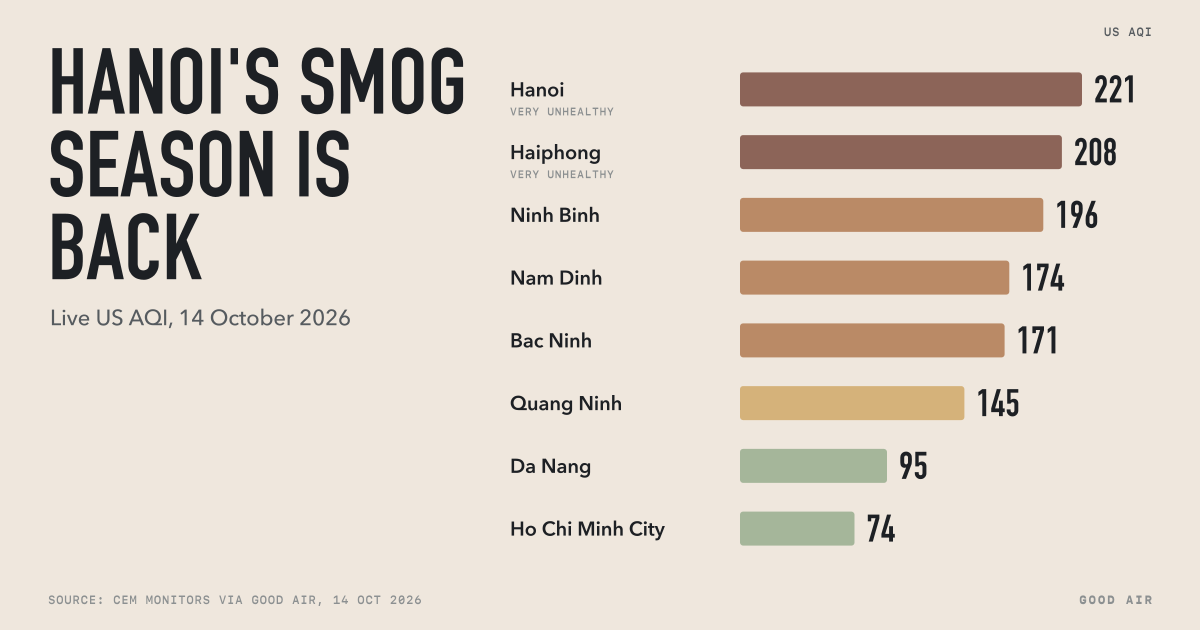
The 14 October snapshot
On 14 October, the worst day of the October spell, Good Air's live list for Vietnam looked like this. Single-hour readings can run well above daily means.
| City | US AQI, 14 October 2026 | Band |
|---|---|---|
| Hanoi | 221 | Very Unhealthy |
| Haiphong | 208 | Very Unhealthy |
| Ninh Binh | 196 | Unhealthy |
| Nam Dinh | 174 | Unhealthy |
| Bac Ninh | 171 | Unhealthy |
| Quang Ninh | 145 | Unhealthy for Sensitive Groups |
| Da Nang | 95 | Moderate |
| Ho Chi Minh City | 74 | Moderate |
Why the smog comes back every October
Two things change in Hanoi in October: the rain stops and the nights get cooler. Clear skies let the ground lose heat quickly after dark, and a layer of cold air forms at the surface under warmer air above. This temperature inversion acts like a lid, trapping smoke and exhaust near the ground until the morning sun warms the surface. Dan Tri reported that the forecast for the week of 12 October called for dry, sunny weather with large day-to-night swings, so the haze was expected to last several days (Dan Tri International, 12 October). That is what our data shows: nine straight Unhealthy days.
Rain and wind clear the air, and October to March is Hanoi's driest stretch. That is why pollution periods in Hanoi mainly fall between October and March (VnExpress International, 15 November 2024).
Where Hanoi's PM2.5 comes from
PM2.5 is the fine dust, under 2.5 micrometres across, that reaches deep into the lungs. Vietnam's Environment Department gives this breakdown for Hanoi and other big cities: secondary particles formed from gases such as nitrogen oxides and sulphur dioxide 27%, road transport 23%, construction and road dust 20%, open burning of waste and crop residue 12%, industry 10% and other sources 8%.

The burning share matters more in October and November, when farmers around the capital clear fields after the rice harvest. Smoke from Indonesia's fires, which has kept Singapore and Malaysia in haze this month, is a separate problem further south; our Southeast Asia haze 2026 article follows it.
Is Hanoi's air getting better?
On the official numbers, 2026 started better than recent years. From 1 January to 29 September, 74.42% of days were rated good or moderate, close to the city's target of over 75%, and average PM2.5 was 37.89 µg/m³. That compares with an annual average of 48.5 µg/m³ in 2025, Nguyen Minh Tan, deputy director of the Hanoi Department of Agriculture and Environment, told VnExpress (11 October).
A good first nine months does not predict the winter. October's spell already pushed Hanoi's mean for the month to 55.5 µg/m³ in our data, and the hardest months are still ahead.
What Hanoi and Vietnam are doing
The city says it is targeting traffic dust, construction dust and open burning (VietnamPlus, 13 October):
- Streets: all 126 communes and wards must step up street cleaning and road washing. From 7 to 15 October the city's sanitation company URENCO trialled mist spraying to settle dust inside Ring Road 1, and proposed three spray trucks on six routes from 11 pm to 6 am (VnExpress, 11 October).
- Construction: sites must cover work, spray water and wash vehicles before they leave.
- Burning: monitoring of open burning and more inspections during the harvest.
- Traffic: a low-emission zone pilot began on 1 July in Hoan Kiem ward. Inside Ring Road 1, petrol motorbikes still make up about 94% to 97% of vehicles. 875 of the city's 1,977 buses (44.3%) have been converted to cleaner power.
A city plan to strengthen pollution control was expected in early October. As of 24 October we could not find it published.
Nationally, the Ministry of Agriculture and Environment has proposed a red alert for days when the AQI tops 300 in eight northern provinces and cities, including Hanoi and Haiphong. Measures under discussion include limiting private motorbikes, free public transport, online classes and remote work for civil servants (Seoul Economic Daily, citing Bloomberg, 22 October). These are proposals; none had been adopted as of 24 October.
How to protect yourself this season
- Check the hour, not the day. The air is usually worst late at night and early in the morning. If you exercise outdoors, the afternoon is often cleaner. Our guide on when it is safe to exercise outside gives AQI thresholds.
- Shut windows on Very Unhealthy days and run an air purifier, if you have one, in the bedroom.
- Wear a well-fitted mask. Cloth and surgical masks do little against PM2.5. See N95, KN95 and FFP2 masks.
- Take extra care with children, older people and anyone with heart or lung disease. On the US AQI, they should cut back on long or hard outdoor activity from 101 upwards. Our explainer on AQI 201 to 300 sets out what Very Unhealthy means.
How we measured
Good Air stores hourly readings from CEM's government monitors. For each UTC day from 15 September to 23 October 2026 we averaged the hourly PM2.5 for Hanoi's city reading, which combines the city's monitors. Two monitors, Nhan Chinh park on Khuat Duy Tien street and 1 Giai Phong street, report almost every hour; a third, at 556 Nguyen Van Cu, reports only a few hours a day at implausibly low values (around 3 to 6 µg/m³) and pulls a few days' averages down slightly. 15 September and 23 October have 15 and 21 hours of data. We use 55.4 µg/m³, where the US AQI reaches 151, as the Unhealthy line. These are daily means of hourly data, so they will not match Vietnam's own AQI exactly.
Frequently asked questions
What is Hanoi's air quality today?
At 10 am on 24 October 2026, Good Air's reading from Vietnam's official CEM monitors put Hanoi at a US AQI of 72, Moderate. Readings change hourly, and the live figure is on Good Air's Hanoi air quality page.
When is Hanoi's pollution season?
It usually runs from October to March. Hanoi's environment department says episodes often begin in October and are most serious from November to March, when calm, dry weather and cold nights trap pollution near the ground.
What was the worst day for Hanoi's air in October 2026?
14 October, when daily mean PM2.5 reached 126.7 µg/m³ and our live reading hit a US AQI of 221. It was the peak of a nine-day Unhealthy spell from 7 to 15 October. The only worse day since mid-September was 22 September, at 129.7 µg/m³.
Is it safe to visit Hanoi in October or November?
Yes, for most healthy travellers, but plan for smoggy days. Check the live AQI each morning, plan outdoor sightseeing for the afternoon, and carry an N95 or KN95 mask. People with asthma or heart disease should take extra care.
Why is Hanoi's air worse than Ho Chi Minh City's?
From 15 September to 23 October 2026, Hanoi's PM2.5 averaged 49.9 µg/m³ and Ho Chi Minh City's 24.0. Hanoi has a cool, dry winter with frequent temperature inversions that trap pollution. Ho Chi Minh City stays warm and gets more rain and wind, which disperse it.